Showing posts with label behaviour. Show all posts

Sunday, May 26, 2013

Cockroach vs. human arms race

Blatella germanica (German cockroach)
German cockroach (via Wikimedia Commons)

The cockroach is a creature that universally elicits feelings of disgust, but anyone who has tried to catch or kill them would also concede a grudging admiration for their toughness. They thrive on the refuse of our human civilization, and it has been said that if the human race somehow managed to wipe itself out through nuclear war, it would be cockroaches that flourish in the ruins.

Much human ingenuity has also gone into designing new and improved ways to kill cockroaches. Sugar laced with poison is commonly used to bait and exterminate these pests. The large-scale deployment of such traps, however, also constitutes a huge inadvertent experiment on the effectiveness of natural selection. Some populations of the German cockroach, Blatella germanica, have become immune to such traps because they are no longer attracted by the glucose sugar used as bait.

Recent research by a team from North Carolina State University (article abstract) has uncovered the physiological basis for this glucose aversion. The sense of taste is mediated by gustatory sensory neurons (GRNs); different substances activate different neurons and trigger different behavioral responses. In normal, wild-type cockroaches, glucose stimulates sugar-GRNs. The researchers found that this is also the case in the glucose-averse cockroaches, but that glucose also additionally stimulates bitter-GRNs, which are usually simulated by substances such as caffeine to which cockroaches are averse. The activation of bitter-GRNs suppresses the usual response of sugar-GRNs and causes the glucose-averse behavior.

This is a nice and neat story that illustrates how quickly natural selection can act, especially considering how numerous the cockroaches must actually be. Whereas evolutionary arms races between most organisms are limited by the rate at which natural selection can act, our human battles against the organisms that we consider pests and weeds are accelerated greatly by the pace of technological change and innovation. This episode shows, however, that natural selection can sometimes keep up and catch us when we are not wary.

Monday, September 17, 2012

Children of the wilderness


A young girl disappears in the forest while playing with a cousin. The cousin is found several days later, but no one can find the girl. Some time later, stories emerge from the forest about a girl seen walking alongside a tiger, about a wild woman walking around with long hair and nails, but she is never found and the search is eventually abandoned. Thirty-eight years later, she is finally rediscovered at the age of 42, after having wandered through the forests on the borders of three different countries. 

This sounds like a chapter from a magical realist novel, or some fairy-tale fable, but it is the true story of Ng Chhaidy from the district of Mizoram in India, close to the border with Myanmar. Chhaidy’s story is astonishing for the length of time that she has been missing, long enough for her to lose the ability to use language, even though she was fluent in her native Mara when she disappeared as a four-year-old. It seems remarkable to those of us living in the developed and urbanized world, far removed from close contact with forest and wilderness, that such a thing could happen in modern times. 

Wednesday, October 12, 2011

Björk and the Zombie Snails

No, it's not a tribute band. The quirky Icelandic musician Björk has a new album out, called Biophilia. Appropriately enough, the tracks are inspired by themes of nature and biology.

One of the songs in particular, "Virus", was written after Björk learned about "zombie snails" on YouTube. It has nothing to do with real viruses, though (Disclaimer: I haven't heard the album yet so I can't say if the music is any good). These snails are parasitized by a trematode worm called Leucochloridium paradoxum, which you can see in the photo below.

Succinea mit Leucocholoridium
Snail infected with Leucochloridium paradoxum in its eyestalk.
Look closely at the eyestalk on the right. Yup, that's filled with worm. But it's not just one worm. It's a structure called the brood-sac, which contains hundreds of cercariae – little larval worms ("trematode life cycle" on Wikipedia. The sac is banded and green and pulsates. This attracts the attention of birds, which think that it's actually their favorite food, maggots or caterpillars. They swoop in and peck off an eyestalk with all the worms in them. The worms end up in the gut of the bird, and are carried in there to be pooped out somewhere else. Free transportation! Snails grazing along eat some bird poop with the parasites in them, and get infected, completing the cycle.

Find out more about the sneaky life cycle of this worm from this article on Wired magazine, or read the Wikipedia article, or just watch the video that inspired Björk:

Tuesday, October 11, 2011

Do plants quiver in fear?

Many trees have leaves that quiver in the wind. This property lends its name to the quaking aspen (below left), whose scientific name Populus tremuloides literally means "trembling poplar". In tropical Asia, the banyan tree (below right) is a commonly-encountered species with quivering leaves. They tend to have fairly broad, thin leaves and narrow, elongated petioles.

Aspen leaves gold backlight close Ficus religiosa Bo
Quaking aspen (Populus tremuloides, left) and banyan (Ficus religiosa, right)
But what exactly is quivering good for? Biophysicists have looked at the way that leaves deform in strong winds, and some have hypothesized that this helps them avoid mechanical damage. On the other hand, it may simply be an unintended consequence of adaptation for other reasons, such as having an appropriate shape and orientation for the efficient capture of sunlight.

A new paper recently available online has suggested that quivering may be a means of avoiding herbivores. The author cites other examples of plant "behavior", such as the Sensitive Plant Mimosa pudica, whose leaflets fold up when touched, startling herbivores while simultaneously exposing the thorns on its twigs. Could quivering serve a similar function?

The author suggests that shaking leaves not only make it harder for small herbivores like insects to land on leaves, they may also cause pests and parasite propagules to be literally shaken off. He also hypothesizes that cryptic herbivores, like leaf and stick insects, would stand out from a background of quivering leaves and be made more vulnerable to their own predators. 

At the moment this stands as only an interesting hypothesis. Most biologists would acknowledge that "theory is cheap, data is expensive". It's fun to think about, but it would be lovely if someone could do some experimental work on it. As a topic in sensory ecology, it reminds me of the hypothesis on why autumn leaves turn red, which was covered in this blog a few years ago. Yet I cannot help thinking that maybe this is reading too much adaptationist significance into what may turn out to be a "spandrel", a trait which is merely a by-product of other traits (a term coined by Steve Gould). 

In the meanwhile, we can look at the leaves that flutter in the breeze and wonder: are they nervously trying to shake off their enemies?

Source:

Kazuo Yamazaki (2011) Gone with the wind: Trembling leaves may deter herbivory. Biological Journal of the Linnean Society, published online before print 3 Oct 2011, doi:10.1111/j.1095-8312.2011.01776.x

Thursday, September 29, 2011

Frogs can "drink" water from air

Thirsty on a hot day? Most of us would reach for a glass of water to gulp down. But what if you could drink through your skin? And what if there isn't any water lying around because it's the dry season in the North Australian tropical savannah?

The green tree frog Litoria caerulea has figured out a clever way to virtually squeeze water out of thin air. Researchers from Australia's Charles Darwin University led by Christopher Tracy were intrigued by how frogs could still remain active even on cool nights, when their body temperatures (being cold-blooded animals, or poikilotherms) could plummet to as low as 12.5ºC. At those temperatures they are sluggish and so are unlikely to be hunting for food. Instead, the scientists thought they might be seeking out water instead.

Pockets of warm air remain in places like tree trunk hollows. Cool objects placed in warm air will tend to condense the water vapour that remains in the air, which is precisely why glasses of cold drinks "sweat" on the outside. They placed some of these chilled frogs into hollows where they also measured the temperature and humidity. Just to be sure, they also used artificial hollows, essentially chambers filled with humidified air.

By weighing the frogs before and after, they found a small (on the order of several tenths or hundredths of a gram) but perceptible gain in mass, which was on average about half a percent of the frog's mass. It doesn't sound like much, but a cup of water is about a quarter of a percent of my total body mass. Droplets of condensed water could also be observed on the frogs after some time.

For more information (and pictures of the frogs), have a look at the press release that went with the paper.

Source


CR Tracy, N Laurence, KA Christian. 2011. Condensation onto the skin as a means for water gain by tree frogs in tropical Australia. The American Naturalist 178 (4): 553-558.

Tuesday, September 06, 2011

Plant gives birds a place to stand

The Cape of Good Hope on the Southern tip of Africa is one of the world's great floristic zones: mega-centers of plant biodiversity where the weird and wonderful have made their home. One of these residents, a member of the Iris family called Rat's Tail, Babiana ringens, has an unusual structure that sticks out vertically, looking much like a rodent's nether appendage.

Botanists from the University of Stellenbosch in South Africa have lately suggested that this structure has evolved as a built-in perch for birds that pollinate the plant's flowers (BBC News, Univ. Stellenbosch). They observed that sunbirds were the only pollinators of these plants, and that the birds perched on the stalk while reaching down towards the flowers. Even more compellingly, in regions where the birds had access to other plant species for nectar, the perches were smaller, an instance of "relaxed selection", where a trait is less pronounced when natural selection is acting less strongly.

All this only serves to confirm my prejudice that animals are merely vehicles for plants to move around in.

Monday, August 22, 2011

Save the Dolphins concert on 28 Aug 2011

Blogger Alex Au, best known for his political blogging, has also highlighted the work of the animal welfare group Acres on his blog Yawning Bread.

He describes their success in alerting the Agri-Food and Veterinary Authority (AVA), Singapore's regulatory authority for the wildlife products trade, to the sale of tiger parts and products in over 50 shops around the island.

Acres is now working to gather more support in its campaign, The World's Saddest Dolphins, to release the dolphins that have been captured for Resorts World Sentosa. 27 bottlenose dolphins were captured from the wild around the Solomon Islands, of which two have since died, which I previously blogged about here. Acres states that:
"Their world has already shrunk to a square sea pen, devoid of variety, bereft of sea life. They can’t hunt anymore. They beg and jump for handouts of dead fish, which arrive in buckets. There’s nowhere for them to roam, except back and forth. And nothing to do except turn round and round and go slowly mad."
These sentiments echo that of the Nobel-prize-winning student of animal behavior, Konrad Lorenz, who wrote in his book King Solomon's Ring:
"Now which are the animals really to be pitied in captivity? ... In the first place, those clever and highly developed beings whose lively mentality and urge for activity can find no outlet behind the bars of the cage. 
... 
"[O]f all the animals that suffer under the inefficient methods of many zoological gardens, by far the most unfortunate are those mentally alert creatures of whom we have spoken above. These, however, rarely awaken the pity of the zoo visitor, least of all when such an originally highly intelligent animal has deteriorated, under the influence of close confinement, into a crazy idiot, a very caricature of its former self."
Acres in collaboration with Young NTUC is hosting a free concert at Hong Lim Park in support of its Saddest Dolphins campaign, from 4:30 to 7:30 pm on the 28th of August (Sunday). Find out more on its Facebook event page

.

Thursday, August 18, 2011

Do chimps have culture?

It's hard being human, or at least, to define what exactly makes us human. It used to be tool-making, but our close cousins the chimpanzees have been found to use tools, such as sticks to gather insects for food. Could culture, the inheritance of behaviors by learning, be the next "exclusively human" trait to fall?

Evolutionary anthropologists are studying chimpanzee communities throughout the West coast of Africa to determine if different groups indeed have different cultures and traditions. There is geographical variation in what specific behaviors chimps exhibit, but this alone does not confirm that there are different traditions:
Deciphering culture in the wild is difficult because researchers must ensure that behavioural differences between groups do not have other causes, such as variation in genetics or environmental conditions. "Why is it all chimps don't do everything? One solution is that there are hidden ecological differences between populations," says primatologist Richard Wrangham at Harvard University in Cambridge, Massachusetts. A behaviour could be linked to any number of variables such as amount of rainfall, the types of tree available, or the kinds of predator in the area, he says.
Read more at Nature News.

Monday, July 25, 2011

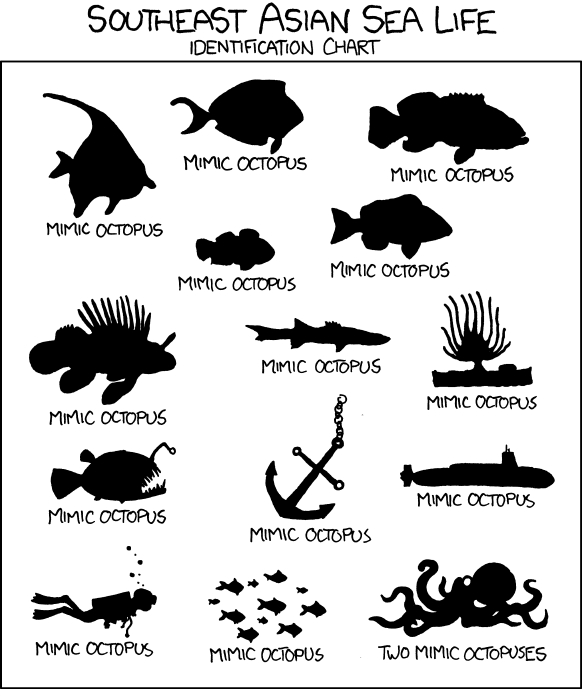
"Southeast Asian Sea Life" according to xkcd

From xkcd.com by Randall Munroe
The latest comic from this popular geeky web-comic pays tribute to the mimic octopus, whose camouflage powers have gained it minor celebrity status on YouTube...

Wednesday, June 08, 2011

Tongues without cheek

It helps to have cheeks. We humans drink by forming a seal around the liquid (and often also the edge of a cup or bottle) with our lips, and then sucking inwards (with the help of our cheeks) to draw it into our mouths. This simple process is not available to other animals, such as dogs and cats, which don't really have cheeks to speak of.

I blogged some months ago about how cats lap up liquids. They don't use suction like we do, but as anyone who's watched a thirsty cat knows, it's all in the tongue. They touch their tongues to the surface of the water, and the liquid naturally adheres to the underside of the tongue. By pulling the tongue back quickly, the adhesion of tongue to water and cohesion between water molecules draws up a thin column of liquid into the mouth of the cat. This happens so quickly that it seems like they are 'flicking' water into their mouths - but no spooning or scooping is involved at all.

They're neat and classy, unlike dogs, right? Dogs seem to make a mess whenever they drink, and in the Times article that I linked to in my previous post, the scientists are quoted as saying that dogs scoop water up with the backs of their tongues, instead of elegantly lapping with the tips of their tongues. But this isn't really the case.


Wednesday, May 11, 2011

Fire ants link up into waterproof rafts

Many insects, such as the aptly-named water-striders, are able to exploit surface tension and literally walk on water. However, the majority are only moderately hydrophobic, and because they are denser than water, have to struggle all the harder to remain afloat the larger they are.

Fire ants live in places which are frequently inundated by water. Individual ants placed in water can float, but not very well. How then do they cope with flooding? It turns out that they assemble themselves into ant 'rafts', cooperating to improve their buoyancy and waterproofing.

Insect cuticle itself is already water-repellent to some extent, but alone it is not enough to explain how a clump of ants, gripping onto each other mandible-to-leg, is more buoyant per unit mass than an individual ant. The answer lies in their ability to trap a layer of air (called a 'plastron') around their bodies. By clumping together, they increase the size of these plastrons, and can entrap larger air bubbles within the clump. These lower the effective density of the ant mass, and also allow them to breathe (insects breathe through pores in their cuticle) even when submerged.

Quotable quotes from the paper:
"Ants were scooped with spoons into 100-mL beakers rimmed with talc powder and weighed to count their numbers. Using the natural adhesion of the ants, a few swirls of the beaker was sufficient to roll the ants into balls."
"Not surprisingly, ant spheres that are placed on solid surfaces quickly disintegrate as the ants flee in all directions."
"By harnessing two live ants with an elastic band, we found that the maximum tensile force between them is F = 620 ± 100 dyn (N = 11), or more than 400 times body weight."
Reference:
Mlot, Tovey, & Hu. "Fire ants self-assemble into waterproof rafts to survive floods." Proceedings of the National Academy of Sciences, USA (10 May 2011) vol. 108 no. 19 pp. 7669-7673.

Monday, April 18, 2011

Cuckoos mimic hawks to scare hosts

Cuckoos have a bad reputation, and it's probably going to get worse. They're known for being brood parasites, depositing their eggs in the nests of other bird species. When these hatch, the cuckoo chicks aggressively demand food from the host parents and also eject their unfortunate step-siblings from the nest. As a result, the cuckoo gets a free pass on child-raising.

It is little surprise that cuckoos coming in to lay their parasitic eggs are often 'mobbed' by the birds that they target, in order to drive them away. However, a recent study has found that 'naive' birds are reluctant to approach cuckoos that have a barred (striped) pattern on their undersides, compared to cuckoos that lack such a pattern. This is interpreted as a form of Batesian mimicry by the cuckoos, taking on the stripes of sparrowhawks, which are birds of prey.

Cuckoos therefore may use two different kinds of mimicry in their lives: as adults mimicking birds of prey to prevent host birds from attacking them, and in the nest mimicking host chicks to convince the host parents to feed them.

Sources:
  • "Cuckoos mimic hawks to scare their hosts, says research," by Victoria Gill. BBC Earth News, 17 April 2011
  • Welbergen, J. A. & N. B. Davies, 2011. A parasite in wolf's clothing: hawk mimicry reduces mobbing of cuckoos by hosts. Behavioral Ecology. First published online 21 Mar 2011, doi: 10.1093/beheco/arr008 [abstract].

Sunday, January 16, 2011

Interspecies Monkey Play

From the NY Times's "Scientist at Work" blog: primatologist Anthony Di Fiore from NYU writes about watching a juvenile spider monkey play with juvenile woolly monkeys in Ecuador, a "a rare, long bout of interspecies play". Sadly the video associated with the article doesn't seem to show the playing monkeys....

Monday, January 10, 2011

Dolphins for Sentosa Resort Moved to Philippines?

The proposed Marine Life Park run by Resorts World Sentosa (RWS) has come under fire for its planned dolphin show ever since word about it got out to the public. The dolphins were captured from the wild in the Solomon Islands and shipped first to the Philippines then to Langkawi, where they have been held for training.

Last October, two (out of seven) were reported to have died from a bacterial infection. In the last month, they have been moved again. According to Today Online:
An employee who wanted to be known as Ahmed, told MediaCorp that the dolphins were put into a container last month and sent to Langkawi's international airport, from where they shipped to the Philippines.
RWS has defended its decision to have a dolphin display by saying that it complied with CITES regulations on the trafficking of endangered species, and that the display would be "educating the public on marine life and environmental issues."

In reply, a member of the public claims that having "dolphins and whales in captivity is not about education or conservation, it is about one thing - profit,"and that the best place to learn from them is in their natural habitat.

Now that nature documentaries have become so advanced both in technical terms and in narrative sophistication, I think that one would learn more from watching a good film about the life and behavior of dolphins, filmed in the wild with wild animals, than from paying to see a handful of caged animals performing tricks. I'm not saying that zoos don't have value; what I have in mind are rare animals whose beauty and fascination lie as much in their behavior and interactions with their natural environment as with their physical appearance. Dolphins certainly fall in this category.

Monday, November 29, 2010

Book Review: The Art Instinct

Book reviewed -- Denis Dutton. The Art Instinct. New York: Bloomsbury Press. 2009.

Modern humans have a profound fascination with our Pleistocene past, in part because many of us, disillusioned by technology and modernity, find something more authentic and natural in the ways of hunter-gatherers. A recent post by fellow Refugee, Alvin, highlights research suggesting that barefoot running may be better for our bodies. For some people, the 'Paleolithic Diet' is becoming fashionable, while even literary theorists are looking to Darwin and the hunter-gatherer psyche to explain the ins and outs of literature. Can other human endeavors, like art and music, be explained by our evolutionary past in the same way?

Tuesday, November 16, 2010

Cats are classy drinkers

Or lappers, to be precise. Unable to sip by suction like we humans do, cats and dogs lap up water with their tongues. However, dogs are much messier than cats, who elegantly flick water into their mouths without splashing it everywhere (what some cats do with their paws later is a separate matter.)

A team of engineers has recently analyzed high-speed photographs of cat lapping to find that they succeed by using only the tips of their tongues to draw up a thin stream of water and then closing their mouths just as the stream begins to break and fall back down again. Scaling up to big cats, they found that their model predicts the speeds that cats of different sizes should lap with (bigger cats lap more slowly).

Just how fast do house cats lap? Here's some trivia for cat lovers: cats lap four times a second, and their tongue moves at the speed of one meter per second, a really rapid, darting movement.

(Via NY Times)

Tuesday, September 21, 2010

Feeling the Burn

I love food, especially spicy food. The sting of chillies adds a good kick to any meal, and makes even a bowl of plain rice palatable. Why should it be so, though? After all, the pain we feel from eating chillies is very real - capsaicin, the active ingredient in chillies, directly stimulates pain receptors in our taste buds. It doesn't make sense that we should enjoy doing something that hurts us, and indeed other animals shy away from them. James Gorman at the New York Times writes about why we like to punish ourselves with chillies, and why these plants are so spicy to begin with.

Thursday, August 26, 2010

Down with Kin Selection?

Oecophylla weaver ants in Gombe. Photo by Axel Rouvin via Wikimedia Commons.

The concepts of kin selection and inclusive fitness are centerpieces of modern evolutionary biology. Almost every biologist has some familiarity with at least the outline of the issue, and they are staples in textbooks and in the classroom. Briefly, these ideas were introduced in the mid-20th century to explain the apparent paradox of how altruism and cooperation might evolve in a biological system. If natural selection favors the spread and fixation of genes that cause an individual to have more offspring, how can we explain the evolution of traits which involve one individual aiding another at some cost to itself?

Cooperation might seem to be intuitively beneficial, but consider a population of animals which all sacrifice a bit of their potential individual fitness in order to cooperate for some greater good, e.g. defending the nest from predators. They will get good returns on their investment if they all cooperated honestly. However, such a group is prone to invasion by so-called 'cheaters', which take but do not give back. A group of cooperators without defences against cheating will rapidly be overtaken by cheaters, and hence any cooperative endeavour is doomed to crumble.

It was to resolve theoretical problems like these that the idea of inclusive fitness was introduced. Individual fitness is simply the number of offspring that one produces. Inclusive fitness, on the other hand, counts not just one's own offspring, but the offspring of relatives, multiplied by the factor of relatedness. The process by which it functions is kin selection - if one helps one's relatives and contributes to their individual fitness, then one is contributing to one's inclusive fitness. A gene for cooperation could hence spread and be resistant to cheating, because it is more likely to be present in relatives of an individual that already bears that gene, than in unrelated individuals. The essence of the idea is found in a prescient quip by the geneticist JBS Haldane, who said that he "would [lay down his life] to save two brothers or eight cousins" (Wikiquote) - because the relatedness (more rigorously, the probability that a gene is identical by descent) of siblings is 1/2 and that of cousins is 1/8.

A new look at the math (the derivations are in the supplementary material, but the main paper is unfortunately hidden behind a paywall) behind inclusive fitness theory is now claiming that it is no better than standard natural selection theory in explaining one of the key problems of biology, the evolution of eusociality (edit 28/8/2010: Harvard Gazette press release). The group, comprising mathematical biologists Martin Nowak and Corina Tarnita, and the father of sociobiology EO Wilson, explain that inclusive fitness is merely a different way of 'doing the accounting' which is somewhat more complicated than it needs to be. That is, it is too specific, relying on certain assumptions (additive fitness effects, pairwise interactions only, weak selection) which are fulfilled in only a few exceptional cases. It is not an adequately general theory, in the mathematical sense of the word. They also challenge the validity of Hamilton's rule, the simple-looking equation that states that a gene for a cooperative behavior will spread if:

Relatedness > cost/benefit

Population biologists trying to test Hamilton's rule in actual organisms have found it difficult to measure these quantities. The authors of this paper, using a more explicit derivation, found that cooperation does spread when something is greater than the cost to benefit ratio, but this 'something' (as they put it) is not relatedness. In place of inclusive fitness theory, they propose that the more general game-theoretic theory of natural selection, used in conjunction with precise models of population structure, is adequate to explain the evolution of cooperation, without invoking kin selection.

What then, of the crown jewel of kin selection, the explanation of eusociality in hymenopterans? Hymenopterans are the insects which include bees, wasps, and ants. They have an unusual genetic system called haplodiploidy: females lay either fertilized (diploid) or unfertilized (haploid) eggs. The former hatch into females, and the latter into males. The ants are perhaps the most successful and best known eusocial animals. Kin selection theory explains the cooperation between female, sterile worker ants (who might easily defect and start laying eggs of their own) in terms of their relatedness - sisters are more closely related to each other (relatedness of 3/4) than daughters are to mothers (1/2), and so cooperation among sisters can spread. Not all eusocial animals have haplodiploid sex determination - termites, for example, do not. As more eusocial animals have been found, it turns out that the number of haplodiploid lineages is in the minority. An alternative explanation has to be found for eusociality, because the kin-selection based explanation as given above was now most probably an exception to the rule.

Naked mole rats are eusocial mammals. Photo via Wikimedia Commons.

Ed Wilson has proposed for some time now that eusociality is to be explained by theories other than the traditional haplodiploid hypothesis (in Quarterly Rev. Biol., Bioscience (pdf), PNAS) . Briefly summarizing, his model, which is adopted and refined in this paper, involves the formation of groups subject to selection, the predisposition to group-formation by certain 'preadaptations' (they cite the example of solitary bees being behaviorally programmed to complete tasks in sequence - hence they naturally divide labor when forced to cohabit), and selection acting at multiple levels. Hence organismal traits and population structure are sufficient, without having to invoke the concept of inclusive fitness.

This analysis is quite satisfying because it represents the convergence of two different approaches to population biology: that rooted in mathematical theory and that rooted in natural history. The strong claims that it makes will certainly trigger robust debate. However it turns out, it will be interesting to see how the study of eusociality will respond. As the authors note (quite provocatively, given the highly charged reception to the original publication of Sociobiology in the 1970s), "[w]e have not addressed the evolution of human social behavior here, but parallels with the scenarios of animal eusocial evolution exist, and they are, we believe, well worth examining."

Wednesday, May 19, 2010

Delusory Parasitosis


"I knew I’d been crazy during that period, but I didn’t know I’d been crazy with a condition that had a name, and that although it wasn’t common, it was well known in psychiatric literature. Not just psychiatric literature. Delusory parasitosis is where psychiatry meets academic entomology and pest control."

Author Jenny Diski writes about delusory parasitosis, also called Ekbom Syndrome, a psychiatric syndrome where a person imagines that he or she is being invaded by tiny invisible bugs. As she tells it, it's something that the unsuspecting entomologist or pest control specialist will be unnerved to encounter for the first time!

The entomologist whom she cites, Nancy Hinkle, has written a review of Ekbom Syndrome for Annual Review of Entomology (2010, vol 55: 77-94, doi:10.1146/annurev.ento.54.110807.090514).

(Scratching cat photo: Pavel Ševela / Wikimedia Commons)

Wednesday, May 12, 2010

Flower-petal coccoons


Bees with a sense of style! The solitary bee Osmia (Ozbekosmia) avosetta from Turkey and Iran uses colorful petals from a legume plant to make its nests; each cell has two layers of petals sandwiching a thin layer of mud. Other Osmiine bees also use petals in their nest construction. A particularly beautiful example of animal architecture.

Original paper from the American Museum Novitates (AMNH), and NPR report with pictures.

(Via Sar)