Showing posts with label A level biology. Show all posts

Thursday, June 03, 2010

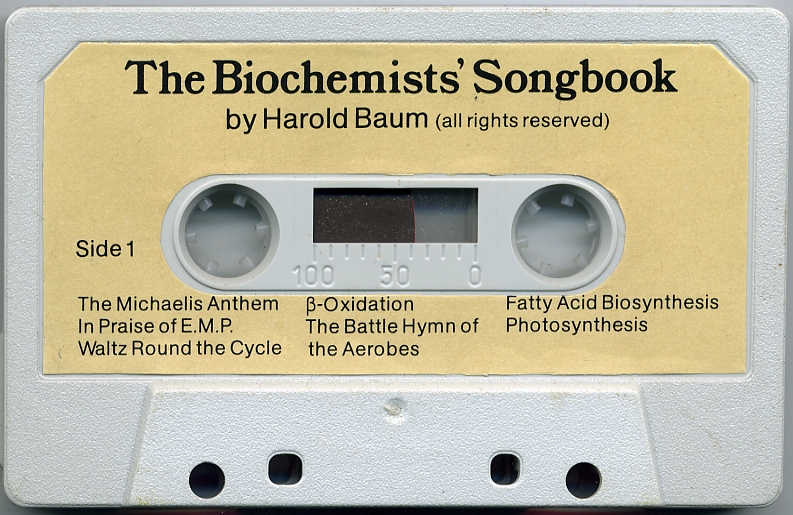
Biochemists' Songbook - Online!


The Biochemists' Songbook is a compilation of songs on biochemical subjects, written to popular tunes, by Harold Baum ("perhaps the world's leading exponent of the biochemical ballad"), who was a professor of biochemistry at Chelsea College, University of London. It was originally published in 1982, and issued with a cassette tape of the songs, which are now available online with the author's permission. Enjoy great hits like 'Photosynthesis' (to the tune of 'Auld Lang Syne'), 'The Glyoxylate Cycle' (to 'The Lincolnshire Poacher'), and many more!

Admittedly only tangentially related to the themes of this blog but it should entertain anyone with fond (or otherwise) memories of A-level Biology.

Tuesday, August 04, 2009

More creationism in schools?

Two articles on creationism in schools have been making their rounds of Singaporean student mailing lists recently.

The first is a report from the Guardian newspaper in the UK that the government agency Naric, which gives information on the standards of 'lesser-known qualifications', has ruled that the International Certificate of Christian Education is equivalent to the A-levels. Seems like a routine piece of news until one reads that:

One of the textbooks tells pupils: "Have you heard of the 'Loch Ness Monster' in Scotland? 'Nessie,' for short has been recorded on sonar from a small submarine, described by eyewitnesses, and photographed by others. Nessie appears to be a plesiosaur."


And this anecdote is supposed to be an item of proof for the falsehood of evolution.

In Singapore, The Online Citizen, a news and opinion website, has run an article raising concerns about creationist viewpoints being 'sneaked' into secular classrooms, both by teachers and by supplementary books which creationist content.

Unfortunately the biologist quoted in the article gives his opinion under a pseudonym. I'm sure that there are practicing scientists out there who would be willing to state their views plainly under their real names. While I agree with his standpoint (i.e. opposed to creationism and anti-evolutionism), I was disappointed in some places by how it was put across.

Referring to a children's encyclopedia that touts the 'Theory of Creation', he says that it is "Rubbish... Stupid", and that: "For this reason alone, this book would be outlawed in a heartbeat and taken off the shelves in the U.S. and in Europe."

Someone familiar with the diffusion of creationist and anti-evolutionist ideas would recognize that the origin of modern creationism is precisely in the United States, and this is where the public debate on the place of creationism in public schools is the strongest. Furthermore, belittling the opposing camp may feel satisfying and win approval from like-minded peers, it does not help in convincing those who espouse creationist ideas that evolution is 'more than a theory' and is based on solid, rational facts and principles.

Creationism's popularity lies in the feeling of embattlement that many religious people feel when they engage with the secular world. As biologists and educators (at least I imagine that is the audience of this blog) we should take care not to escalate the tension. Our frame of mind should be that of persuasion, regardless of how strongly-held our views are, because it is very hard to convince someone in a hostile mood.
Wednesday, November 12, 2008

"What our Biology students are learning" - a 2008 update

Warren Tan of The Warren, recently provided an update on his biology experience in JC (= "high school") in the comments section of Brandon's 2007 post, "What our Biology students are learning". He was responding to Brandon's query, "What do you find most interesting about biology, and do you find that what you learned in school fulfills that?"

I reproduce his comment here to highlight his update on the 'A' level biology scene:

"Me personally, i like microbiology/cell biology. I was also very fortunate that in my secondary school(and later JC1), i was chosen to participate in research programme in that field.

So at least for me, i do find H2 biology interesting. (most of classmates don't however)

Our batch was the "transition of syllabus" batch. We barely touched on molecular biology in secondary school, and many of my us found it hard to adapt to the new focus in H2 biology. (it was better for me, due to my research exposure, but i do empathise with my classmates)

I fully agree that system biology and ecology is important, and the lack of coverage in the current H2 biology could be a liability. The syllabus assumes we had covered sufficiently in sec/pri school. Nevertheless, i think keeping in touch and expanding existing knowledge is important.

SPA was the greatest complain me and my classmates had. Because, each assessment is important, the college had no choice but to chose experiments we can do well in, over anything else. We end up memorising standard answers 99% of the time.

Also, our teachers explained that experiments can be expensive and tedious to prepare. As Junior College, funds are limited.

Until funds specially are set aside for "Poly/Uni level" experiments, and until they would be duly recognised for assesment, it may be hard to move beyond osmosis experiments. (at least for the mainstream students). Research and H3 students had more opportunities and exposure.

In conclusion, it may not be that the syllabus is too skewed. But that, opportunities for an expansive biology education are too few and far in between. Not many people can qualify for H3 subjects. The idea of SPA may need to be revised.

The situation may be better for the the next few batches, since they are under the new syllabus since secondary school (unlike us whom are the transition batch)"


Link: "What our Biology students are learning," by Brandon Seah. The Biology Refugia, 01 Apr 2007.