Showing posts with label mammals. Show all posts
Showing posts with label mammals. Show all posts
Friday, April 13, 2012
Visiting the Hunterian Museum
I have always been enthralled by dissection and the appearance of well-dissected specimens. It's a strange kind of art form: the structure is already there, formed by the hand of Nature, so the artist's job is not to create something new, but to reveal something hidden. In school I participated in biology competitions where we trained on dissecting earthworms, cockroaches, flowers, and the like, while in college I had a memorable experience cutting open a gravid dogfish with a friend.
But the enthusiastic hacking of amateurs and students is one thing, while the preparation of display specimens is another. The Hunterian Museum is one of the most well-known collections of its kind. It's owned by the Royal College of Surgeons of England, and was originally put together by John Hunter, the famed 18th century anatomist and surgeon, some of whose exploits have been described before on this blog. I recently got to visit the museum because I was in London, and despite it being a relatively small collection (two thirds of the original collection was lost by bombing during World War II), I spent more than 2 hours wandering around. Unfortunately photography is forbidden, so no photos this time.
Used for both teaching and research, it is notable for its bringing together of both human and non-human (including plants!) specimens in a systematic arrangement. Unlike most museums of the time, which arranged things in a taxonomic layout (according to classification), Hunter arranged his museum to demonstrate his ideas of comparative physiology and anatomy. For example: flowers, eggs, uteruses would be brought together in one case under the heading "organs of reproduction". What struck me was the range of non-human material that was present. I had read about this before, but actually seeing the collection led me to appreciate how deeply Hunter was trying to draw analogies between the different classes of life (before the advent of evolution theory), which is a project that biologists today are still working on.
There were lots of children with their parents, when I was visiting. One would think that a young child would be terrified of seeing recognizable pieces of people (some of the specimens were stained and looked quite lifelike), but I don't think most of them were too put off by it. Perhaps the sheer quantity of stuff to see distracted them from the particularly morbid examples. One case that did give many visitors some pause was the display of human fetuses at various stages of development. I heard one parent mutter "that can't be right...."
Halfway through my visit, the children trooped off to hear a presentation in period costume about 18th century surgeons, and I was left in near-silence again, with a few other people who were sitting on stools and making drawings. In the upper floor of the gallery are the pathological specimens, collected to demonstrate the different diseases and abnormalities that a practicing surgeon might encounter. Some of these show how "nasty, brutish, and short" life was like before antibiotics and modern medicine: skulls devastated by syphilis, spines bent over by tuberculosis. The smallpox exhibit was especially heartbreaking, because it contained half the face of a child victim of smallpox, to illustrate the scarring. It was injected with red dye to stain the arteries, but that also gave a rosy glow to the cheeks.
Another disconcerting thing is seeing specimens that come from named persons: a cancerous tumor from Miss Somebody, a diseased body-part from Lord Someplace. Hunter was a surgical innovator, but that also meant that many patients died anyway, and their body parts would end up in his collection.
Hunter's skill in anatomical preparation, and the care taken by conservators in the years since, have kept much of the collection in very good shape. I marveled especially at the dissections of invertebrates to demonstrate the nervous system: one of the most challenging things to display in a tiny animal. Sadly, the anatomist's art is in defiance of nature: to unveil the concealed, to prevent decay, and to simulate the appearance of life. Even if specimens are well conserved and do not decay, plenty of work is involved, and they are ever prone to destruction because most are highly flammable and fragile. One photograph on display from 1941 shows the aged retired curator Arthur Keith helping to salvage from the wreckage after the bombing, beside a bust of Richard Owen, the 19th century anatomist, poking out from the rubble. An anatomist's lifetime's work could be easily reduced to ashes within minutes, but on reflection, it is the knowledge gained that is most precious. The medical anatomists are fortunate in that their hard-won learning is valuable to society and is therefore carefully passed on. The comparative biology of other organisms, however, suffers from a lack of qualified taxonomists and specialists in many groups. Even today we need more people like John Hunter, who are driven to seek out the connections between the familiar and the unfamiliar, the immediately relevant and the merely philosophical.
(For those who are visiting London: The museum is free, and is open Tuesdays to Saturdays, 10 am to 5 pm. It is located beside Lincoln's Inn Fields; the nearest Tube stop is Holborn.)


Tuesday, July 19, 2011
The mole's new thumb
  |
| Two instances of making do with what you have at hand. |
This same wrist bone is also modified in giant pandas to form their peculiar 'thumb'. The panda uses its false thumb in feeding, to strip down the bamboo shoots that comprise its diet. (A photo of this in action can be found here.) This was the subject of a well-known essay by Stephen Jay Gould that later titled one of his published collections. As an example of what he called 'Tinkertoy evolution', it illustrates how evolution often makes do with existing structures to fulfill new functions. It is examples like these, which are less than perfect and highly contingent functional solutions, that break the illusion of a perfect world as posited by natural theology, and demonstrate evolution in action, he argued. (It's also the name of a popular evolution blog.)

The case of the mole's 'thumb' also bears out this theme. Developmental biologists have recently found that Sox9, a gene involved in limb chondrification (the formation of cartilage tissue), is expressed in the region of the enlarged radial sesamoid during the development of the front paws of a mole embryo. This gene is also expressed in the 'normal' developing digits. However, the timing is different: it is expressed in that region of the wrist after Sox9 expressed has faded away in the normal digits. They compared this pattern of gene expression in embryos of the shrew, which are the closest relatives to moles, and did not find any Sox9 expression in the wrist at the same developmental stages.
Therefore, similar developmental mechanisms (the 'toolbox') have been co-opted to form the mole's false thumb, but their timing has been changed. That seems an easier option than to invent an entirely new set of tools.
Instances of obvious 'tinkering' such as this one make the messiness of evolution more apparent to us. Even structures of of evident perfection such as the eye (or eyes, since image-forming eyes have evolved multiple times) evolved by a long process of making do with existing structures to form new ones (clip from the BBC science show 'Bang Goes the Theory'). After all, isn't this just descent with modification, the very concept of biological evolution itself? Even at the level of genes and genomes, new genes often originate by duplication of existing genes (or even entire genomes, in the phenomenon of polyploidy) followed by divergence in function of these new copies from their originals. A whole book has recently been published on this subject.
What intrigues me is that the evolution of language also seems to have a similar pattern, and not just in terms of coining new words or borrowing vocabulary from other languages, but in the very grammatical structure of a language. Apparently 'perfect' systems like the Latin noun cases are actually the intermediate products of an ancient and on-going process of decay, accretion, and modification. A readable account is found in a popular-linguistics book I recently read, The Unfolding of Language.
Perhaps I'm straying too far from the original point of this post, and making a mountain out of a molehill, but the parallels to be found throughout the natural world and between the different sorts of evolution, biological and cultural, continue to fascinate me. Nature has immense and dizzying diversity, but that doesn't mean it has to be opaque to our understanding.
Instances of obvious 'tinkering' such as this one make the messiness of evolution more apparent to us. Even structures of of evident perfection such as the eye (or eyes, since image-forming eyes have evolved multiple times) evolved by a long process of making do with existing structures to form new ones (clip from the BBC science show 'Bang Goes the Theory'). After all, isn't this just descent with modification, the very concept of biological evolution itself? Even at the level of genes and genomes, new genes often originate by duplication of existing genes (or even entire genomes, in the phenomenon of polyploidy) followed by divergence in function of these new copies from their originals. A whole book has recently been published on this subject.
What intrigues me is that the evolution of language also seems to have a similar pattern, and not just in terms of coining new words or borrowing vocabulary from other languages, but in the very grammatical structure of a language. Apparently 'perfect' systems like the Latin noun cases are actually the intermediate products of an ancient and on-going process of decay, accretion, and modification. A readable account is found in a popular-linguistics book I recently read, The Unfolding of Language.
Perhaps I'm straying too far from the original point of this post, and making a mountain out of a molehill, but the parallels to be found throughout the natural world and between the different sorts of evolution, biological and cultural, continue to fascinate me. Nature has immense and dizzying diversity, but that doesn't mean it has to be opaque to our understanding.
Sources:
- BBC News story by Jennifer Carpenter
- C Mitgutsch et al. (2011) Circumventing the polydactyly 'constraint' - the mole's thumb. Biology Letters published online 13 July 2011. doi: 10.1098/rsbl.2011.0494
Wednesday, June 08, 2011
Tongues without cheek
It helps to have cheeks. We humans drink by forming a seal around the liquid (and often also the edge of a cup or bottle) with our lips, and then sucking inwards (with the help of our cheeks) to draw it into our mouths. This simple process is not available to other animals, such as dogs and cats, which don't really have cheeks to speak of.
I blogged some months ago about how cats lap up liquids. They don't use suction like we do, but as anyone who's watched a thirsty cat knows, it's all in the tongue. They touch their tongues to the surface of the water, and the liquid naturally adheres to the underside of the tongue. By pulling the tongue back quickly, the adhesion of tongue to water and cohesion between water molecules draws up a thin column of liquid into the mouth of the cat. This happens so quickly that it seems like they are 'flicking' water into their mouths - but no spooning or scooping is involved at all.
They're neat and classy, unlike dogs, right? Dogs seem to make a mess whenever they drink, and in the Times article that I linked to in my previous post, the scientists are quoted as saying that dogs scoop water up with the backs of their tongues, instead of elegantly lapping with the tips of their tongues. But this isn't really the case.
I blogged some months ago about how cats lap up liquids. They don't use suction like we do, but as anyone who's watched a thirsty cat knows, it's all in the tongue. They touch their tongues to the surface of the water, and the liquid naturally adheres to the underside of the tongue. By pulling the tongue back quickly, the adhesion of tongue to water and cohesion between water molecules draws up a thin column of liquid into the mouth of the cat. This happens so quickly that it seems like they are 'flicking' water into their mouths - but no spooning or scooping is involved at all.
They're neat and classy, unlike dogs, right? Dogs seem to make a mess whenever they drink, and in the Times article that I linked to in my previous post, the scientists are quoted as saying that dogs scoop water up with the backs of their tongues, instead of elegantly lapping with the tips of their tongues. But this isn't really the case.
Monday, January 24, 2011
Latest named cat species actually two subspecies
The Sunda clouded leopard (Neofelis diardi) was recognized as a distinct species, separate from the mainland Southeast Asian clouded leopard N. nebulosa, in 2008. Both are Vulnerable species, according to the IUCN.
Based on molecular genetic data, researchers suspected that the Sunda clouded leopard might actually represent two different subspecies, and this has been confirmed by a combination of molecular genetics and skull/dental features. There may be additional differences in coat patterning, but the number of specimens available for inspection is not enough to make a definitive statement.
The two subspecies are geographically separated: the Sumatran subspecies (N. diardi diardi) and the Borneo subspecies (N. diardi borneensis). They were probably isolated from each other after Sundaland land bridges were cut off when sea levels rose after the last ice age.
The BBC has a good summary article including a rare video of the animal from Dermakot National Park in Sabah, Borneo.
Based on molecular genetic data, researchers suspected that the Sunda clouded leopard might actually represent two different subspecies, and this has been confirmed by a combination of molecular genetics and skull/dental features. There may be additional differences in coat patterning, but the number of specimens available for inspection is not enough to make a definitive statement.
The two subspecies are geographically separated: the Sumatran subspecies (N. diardi diardi) and the Borneo subspecies (N. diardi borneensis). They were probably isolated from each other after Sundaland land bridges were cut off when sea levels rose after the last ice age.
The BBC has a good summary article including a rare video of the animal from Dermakot National Park in Sabah, Borneo.
Wednesday, December 22, 2010
The Elephants' New Tree


Top (L to R): African Savannah Elephant, African Forest Elephant, Asian Elephant
Bottom (L to R): Woolly Mammoth, Mastodon
Source: Wikimedia Commons (click through for source pages)
African Elephants have big ears, Asian Elephants have small ears - that's how we usually learn to tell these two apart. The "African Elephant", though, actually comprises two species in the genus Loxodonta, the Savannah elephant (L. africana) and the Forest elephant (L. cyclotis). The Asian elephants are not as closely related as these two, and are in the genus Elephas. Whether the two species of African elephants are really distinct species, however, has been a subject of debate ever since they were first described by zoologists. New research, however, shows that they are indeed different species, and that this divergence is an ancient one. What's more, the Asian elephant is a closer relative to the woolly mammoth than it is to the extant African elephants!
A scientific team led by researchers from the Broad Institute at Cambridge, Massachusetts and the Max Planck Institute for Evolutionary Anthropology in Leipzig have used DNA from the three extant elephant species as well as ancient DNA from the Woolly Mammoth (Mammuthus) and the Mastodon (confusingly called Mammut) to reconstruct the Proboscoidean family tree. What's really novel about their methodology is that they have used tens of thousands of nucleotides of DNA sequence data, spanning several hundred loci (genes) on the nuclear genome of these elephants. Most phylogenetic studies (i.e. research that aims at reconstructing the genealogy of organisms) generally looks at only a handful of genes because large quantities of data are expensive (money-wise) to produce and computationally expensive to crunch through. They took advantage of the Broad Institute's expertise in next-generation pyrosequencing, where DNA is "sequenced by synthesis", based on technology that is fundamentally different from the decades-old Sanger sequencing technology that we learn about in school.
Their results are based on nuclear genes, but show a conflict with previous results obtained by analyzing the mitochondrial genome (mtDNA) of these elephants. mtDNA suggests instead that the African elephants share a relatively recent common ancestry, within the past half-million years or so. What could be happening is that mitochondrial and nuclear genomes are evolving under different circumstances, because the mitochondria are inherited only through the maternal line. The authors hypothesize that this difference is caused in part by the matriolcal behavior of elephants - matriarchal herds stay more or less in the same place, while waves of male migration spread out and fertilize herds elsewhere, displacing nuclear genes but not mitochondrial ones.
The value of ancient DNA is now well-recognized, and has entered the mainstream in science, where previously it tended to be viewed askance as a fringe endeavor more associated with science fiction than real science (think Jurassic Park). What I'd like to see this research group do in the future is to obtain sequences from a larger pool of animals. At present they have DNA sequences from only one or two individuals of each species. A larger data set would allow us to see how well-supported the nuclear-mtDNA divergence really is, and what degree of variation is present at the populational level for this species. As sequencing costs and computational costs go down, it will certainly be cheap enough, one day, to do large-scale population genetics at hundreds of loci. Also, it would have been valuable to see what tree topologies they would obtain using other tree-building methods, because neighbor-joining is known to produce branch lengths that are difficult to interpret, and information is lost when compressing data into distance metrics.
Monday, December 13, 2010
Can you fool a baby panda?
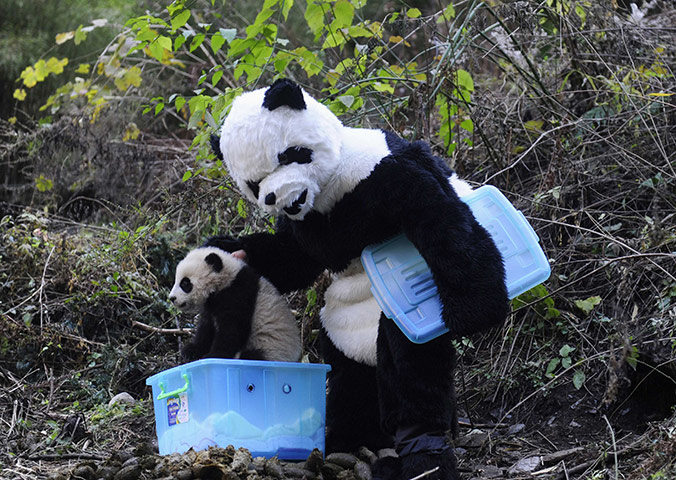 |
| Source: Reuters, via The Guardian |
How effective is this? Only time will tell. In the meanwhile, enjoy the bizarre photographs....
Wednesday, December 08, 2010
Egyptian crypt aids search for origin of dogs
One of the most charming and enjoyable books about dogs is Man Meets Dog by Konrad Lorenz, who was one of the founders of the field of ethology, or the scientific study of animal behavior. This book popularized ethology but unfortunately one of Lorenz's other theories, that dogs were descended from jackals, has been found by more recent scientific work to be wrong. Dogs are most probably descended from wolves, which seems mind-boggling if we look at the tremendous variety of dog breeds. How did they all come about?
It is in this context that the rediscovery of a crypt for dog bones in Saqqara, Egypt is significant. These animals were sacrificed upon the death of their owners, and were entombed underground, sometimes mummified. Although ancient Egyptians were known for their love of cats, there was a significant interest in dogs and dog-breeding among them too. This crypt therefore preserves for us, like a snapshot in time several millennia ago, a cross-section of dog variation in the course of their domestication that may give some insight into the evolution of modern breeds, and their origin from wolves.
It is in this context that the rediscovery of a crypt for dog bones in Saqqara, Egypt is significant. These animals were sacrificed upon the death of their owners, and were entombed underground, sometimes mummified. Although ancient Egyptians were known for their love of cats, there was a significant interest in dogs and dog-breeding among them too. This crypt therefore preserves for us, like a snapshot in time several millennia ago, a cross-section of dog variation in the course of their domestication that may give some insight into the evolution of modern breeds, and their origin from wolves.
Friday, November 26, 2010
Panthers and Leopards in the Malay Peninsula
The term 'panther' has a confusing history - it's been used to refer to any big, black (i.e. 'melanic') cat, usually the leopard in particular. Leopards and panthers used to be thought of as different species, but they are in fact merely different color variants, and this so-called melanic coat coloration is a recessive Mendelian trait. To complicate matters, the four big cats - leopards, tigers, lions, jaguars - have been grouped in the genus Panthera, based on the same etymological root.
In Southeast Asia, the leopard Panthera pardus exists in two color morphs: the usual spotted variety, and the melanic 'panthers'. However, a recent evaluation of camera-trap data could not find any spotted leopards South of the Isthmus of Kra; all the animals that were photographed by these traps were black leopards. Anecdotal evidence from interviews with aboriginal peoples living in national parks also found that they were unfamiliar with the spotted leopards but could recognize the black ones. Although 'absence of evidence is not evidence of absence', it does show that spotted leopards are at the very least rare in Malaysia. The authors of this study suggest that this trait has become genetically fixed because of a bottleneck event sometime in the history of this population. This is a neat intersection between basic natural history and genetics, having implications for the genetic variability of the Malayan leopards, and hence their conservation viability.
In Southeast Asia, the leopard Panthera pardus exists in two color morphs: the usual spotted variety, and the melanic 'panthers'. However, a recent evaluation of camera-trap data could not find any spotted leopards South of the Isthmus of Kra; all the animals that were photographed by these traps were black leopards. Anecdotal evidence from interviews with aboriginal peoples living in national parks also found that they were unfamiliar with the spotted leopards but could recognize the black ones. Although 'absence of evidence is not evidence of absence', it does show that spotted leopards are at the very least rare in Malaysia. The authors of this study suggest that this trait has become genetically fixed because of a bottleneck event sometime in the history of this population. This is a neat intersection between basic natural history and genetics, having implications for the genetic variability of the Malayan leopards, and hence their conservation viability.
Tuesday, November 16, 2010
Cats are classy drinkers
Or lappers, to be precise. Unable to sip by suction like we humans do, cats and dogs lap up water with their tongues. However, dogs are much messier than cats, who elegantly flick water into their mouths without splashing it everywhere (what some cats do with their paws later is a separate matter.)
A team of engineers has recently analyzed high-speed photographs of cat lapping to find that they succeed by using only the tips of their tongues to draw up a thin stream of water and then closing their mouths just as the stream begins to break and fall back down again. Scaling up to big cats, they found that their model predicts the speeds that cats of different sizes should lap with (bigger cats lap more slowly).
Just how fast do house cats lap? Here's some trivia for cat lovers: cats lap four times a second, and their tongue moves at the speed of one meter per second, a really rapid, darting movement.
(Via NY Times)
A team of engineers has recently analyzed high-speed photographs of cat lapping to find that they succeed by using only the tips of their tongues to draw up a thin stream of water and then closing their mouths just as the stream begins to break and fall back down again. Scaling up to big cats, they found that their model predicts the speeds that cats of different sizes should lap with (bigger cats lap more slowly).
Just how fast do house cats lap? Here's some trivia for cat lovers: cats lap four times a second, and their tongue moves at the speed of one meter per second, a really rapid, darting movement.
(Via NY Times)
Monday, July 13, 2009
NY Times feature on whales and us
"Human-whale relations have long been defined by this stark dualism: manic swings between mythologizing and massacre; between sublime awe and assiduous annihilation, the testimonies of their slayers often permeated with a deep sense of both remorse and respect for the victims."
In between these extremes, the relationship between humans and whales turns out to be social and complex. Among themselves, whales have languages, communities, and actually resemble us more than we would care to admit. So given our history of hunting whales and driving them to suicide by the cacophony of underwater sonar, could they find it in their hearts to forgive us?
Towards its conclusion, this article by Charles Siebert raises the issue of anthropomorphism. Because of the close parallels in their behavior and sociality to that of our own species, it is tempting to suppose that whales and other cetaceans have feelings and motivations like we do, that they feel sadness or gladness when they display aversion or preference.
Anthropomorphism has long been the big taboo in the field of ethology, because of the concern that it is unscientific and sentimental, so generations of behaviorists have been taught to refer to their animal subjects by numbers rather than names, and to carefully suppress their instinct to ascribe human-like motivations and feelings to them. The scientist that the author quotes, Toni Frohoff, is quick to say: "I don't anthropomorphize", but also that "those who would reject out of hand the idea that whales are intelligent enough to consciously interact with us haven’t spent enough time around whales."
The intuition of a seasoned and experienced observer encodes subtle nuances and detail that the hypothesis-testing model of science can be blind to. The question, of course, is how to translate the ineffable quality of a humpback gently nudging a dive team that had recently freed it from a tangle of rope into some convincingly systematic scheme of explanation. It would be very satisfying if the rigorous study of cetaceans can give us insight into whether these animals, like us, are able to lead rich and interesting internal lives.
Wednesday, December 31, 2008
The 'Passive House' and the Seal's Flipper
It's wintertime in the Northern Hemisphere and word of something snug, warm, and money-saving will certainly receive a lot of attention or a lot of envy. Therefore it is no surprise that the Passive House concept (Passivhaus in German) is being widely reported in the American news (the New York Times's most-emailed article for the past day or two) as a great European invention that could potentially help Americans cut their considerable expenditure on heating. One happy German family reports that they get "all the heat and hot water they need from the amount of energy that would be needed to run a hair dryer." How does it work? Wikipedia helpfully explains the following points of design that contribute to a warm house (though the diagram is still in German...):
- Very efficient insulation (including super airtight windows)
- Orientation to pick up solar energy
- Using passive heat sources like body heat and appliances
- Shunting ventilation through a heat exchanger
The last element is also known as a heat recovery ventilation system (description) and works by having incoming fresh cold air be in thermal contact with outgoing stale warm air, so as to transfer some of the heat from the outgoing air to the incoming air, and reducing the heat loss through the ventilation system. The air is not being mixed, rather they are fed through closely interlaced tubing that maximize heat transfer between the two streams. How does such a simple system achieve such high efficiency? The New York Times article describes an exchanger that retains up to 90% of the heat. This would seem incredible if not for the fact that animals of cold environments have been using the same passivhaus design for a long time.
Like a passivhaus, the seal has a superb insulation system of blubber and fur. On top of that, it has its own heat exchanger system to minimize heat loss from the body's interior to the external environment. This heat exchanger is the counter-current exchange system, found in the seal's flipper and in the limbs of many other animals. The problem that it solves is how to keep the extremities supplied with blood while losing as little heat as possible (because arterial blood coming from the heart is essentially at core body temperature - as anyone who has been disconcerted by the warmth of his own blood in the tubing at a blood donation drive can attest). In a counter-current system, the arteries (carrying warm, oxygenated blood from the heart) run parallel to and in contact with the veins (carrying cool, deoxygenated blood back to the heart), but with the blood flow in opposite directions, i.e. in a loop. At the steady-state, this will result in a temperature gradient in both vessels will be such that the innermost end is warmest, and the outermost end is the coolest.
This serves two purposes: (1) the blood returning in the vein at the base of the limb is warmer than the venal blood at the tip of the limb, hence the core body warmth of the animal is protected, and (2) the average temperature of the limb is reduced, which is desirable. After all, a high average temperature in the limb means that there is a higher temperature gradient between the limb and the environment, hence a higher rate of heat loss, by Newton's law of cooling.
So a simple arrangement of tubing can lead to dramatic improvement in function. Countercurrent exchangers are also found in other organs and body parts. For example, tuna use a countercurrent system in its body wall to keep its active swimming muscles warmer than the surrounding water. Fish also use a countercurrent system to maximize yield of oxygenation in their gills. A countercurrent arrangement can also be used actively (rather than passively), e.g. in the loops of Henle in the kidney, to actively concentrate the urine, and in the rete mirabile of fishes, to actively concentrate gas in the swim bladder. Doubtlessly there are many points of similarity between German houses and seals (or tuna, or kidneys) but the use of a countercurrent exchanger is probably one of the more ingenious among them!
Friday, March 21, 2008
Moose antlers help hearing
The big antler racks of moose may help males amplify sounds to better locate females:
http://www.guardian.co.uk/science/2008/mar/21/medicalresearch.animalbehaviour
Researchers used a set of Alaskan moose antlers, and placed a prop ear and a microphone between them, and measured the sound reaching the microphone with and without the antlers. With the antlers, head-on sound was amplified by 19%, but when the antlers were turned away from the sound, it was decreased by 21%, suggesting that they help in direction finding, just like how our external ears (auricles) are directed towards our front.
http://www.guardian.co.uk/science/2008/mar/21/medicalresearch.animalbehaviour
Researchers used a set of Alaskan moose antlers, and placed a prop ear and a microphone between them, and measured the sound reaching the microphone with and without the antlers. With the antlers, head-on sound was amplified by 19%, but when the antlers were turned away from the sound, it was decreased by 21%, suggesting that they help in direction finding, just like how our external ears (auricles) are directed towards our front.
Wednesday, August 08, 2007
Yangtze River Dolphin extinct?
An intensive survey carried out to locate remaining individuals of the critically endangered Yangtze River Dolphin, or baiji, a freshwater dolphin endemic to that river and the only surviving representative of its family, has not been able to find any of the dolphins. According to IUCN criteria, however, this species cannot be formally classed as extinct because Red List rules stipulate that 50 years must have passed since the last verified sighting of the organism. However, very few surveys of such detail have been carried out for the Yangtze River Dolphin, so the IUCN Red List's entry on this dolphin is probably too optimistic in its estimates, and the baiji is probably either gone for good, or with too few numbers in the wild to survive for very much longer.
Numbers of baiji have always been low; estimates in the 1980s ranged from 100 - 400, with sightings of the animals usually in groups, but a more recent survey in 1997-9 sighted just over 20 individuals. This present survey covered the 1669 km length of the Yangtze between Yichang and Shanghai twice, using visual and acoustic methods. The authors point out that the baiji is primarily a victim of 'incidental mortality', unlike other recently extinct or endangered animals, such as the dodo and tiger, which are victims of hunting and trapping. What killed off the dolphin population was a combination of pollution and habitat degradation, as well as accidental killing from booming river shipping traffic and fishing activity.
The fact is that 'even large charismatic and nominally protected animals are still in grave danger of being lost', and just because an animal is on the Red List, is widely known, and is discussed at international meetings or in the media, doesn't mean that anything concrete is being done about its death and decline. In this respect it reminds me of the case of the Indian tiger and how its wild populations may have been systematically underestimated for years, while illegal poaching and trade in tiger parts has still persisted even in supposedly protected wildlife reserves. Furthermore, while the death of a big mammal is a tragic and dramatic wake-up call, it's clear that the extinctions that we're not aware of are still proceeding unabated and will continue to do so even if governments enforce conservation laws more strictly.
Reference: Turvey, S.T. et al. 2007. "First human-caused extinction of a cetacean species?" Biology Letters, 3(5): 537-540; published online: doi:10.1098/rsbl.2007.0292.
Numbers of baiji have always been low; estimates in the 1980s ranged from 100 - 400, with sightings of the animals usually in groups, but a more recent survey in 1997-9 sighted just over 20 individuals. This present survey covered the 1669 km length of the Yangtze between Yichang and Shanghai twice, using visual and acoustic methods. The authors point out that the baiji is primarily a victim of 'incidental mortality', unlike other recently extinct or endangered animals, such as the dodo and tiger, which are victims of hunting and trapping. What killed off the dolphin population was a combination of pollution and habitat degradation, as well as accidental killing from booming river shipping traffic and fishing activity.
The fact is that 'even large charismatic and nominally protected animals are still in grave danger of being lost', and just because an animal is on the Red List, is widely known, and is discussed at international meetings or in the media, doesn't mean that anything concrete is being done about its death and decline. In this respect it reminds me of the case of the Indian tiger and how its wild populations may have been systematically underestimated for years, while illegal poaching and trade in tiger parts has still persisted even in supposedly protected wildlife reserves. Furthermore, while the death of a big mammal is a tragic and dramatic wake-up call, it's clear that the extinctions that we're not aware of are still proceeding unabated and will continue to do so even if governments enforce conservation laws more strictly.
Reference: Turvey, S.T. et al. 2007. "First human-caused extinction of a cetacean species?" Biology Letters, 3(5): 537-540; published online: doi:10.1098/rsbl.2007.0292.
Subscribe to:
Posts (Atom)