Showing posts with label palaeontology. Show all posts

Tuesday, January 29, 2013

United States of America vs. One Tyrannosaurus bataar Skeleton

Many countries have laws to prevent the export of fossils and other natural treasures, including Mongolia, which encompasses the Gobi Desert, a rich source of dramatic dinosaur fossils. However, "fossil poaching" is rife, given the vastness of the desert and the lucrative profits that can be made on the high-end fossil market. When a three-quarters-complete Tyrannosaurus bataar skeleton went on auction in New York in 2012, the Mongolian government asked US authorities to intercede, because it had likely been illegally smuggled out of Mongolia. The sale was halted, and the fossil put into storage as the legal challenge moved forward:
"Two weeks later, in downtown Manhattan, the U.S. attorney for the Southern District of New York sued for custody of the specimen, on behalf of the nation of Mongolia. Procedure required that an arrest warrant be issued against the dinosaur itself, so the action became known as United States of America v. One Tyrannosaurus Bataar Skeleton."
Read more on the story of this outrageously brazen auction attempt, and the legal battle that ensued.

Update (9 May 2013): The bones were handed over by the US to the Mongolian government on Monday, putting this legal saga to an end. According to the Mongolian culture and tourism minister, they intend to set up a dinosaur museum in Mongolia, as they do not currently have such a museum to display their fossils. It's surprising that they don't have one already, given the importance of the Gobi Desert as a source of important and dramatic vertebrate fossils.

Sunday, January 01, 2012

Are they embryos or not?

Once again, news about fossils (I promise that I'm not turning this into a paleontology blog).

The Doushantuo Formation in China is one of the most important sites for pre-Cambrian microfossils. These date back to before the Cambrian Explosion of animal life in prehistoric seas, exactly where you'd want to go looking if you were interested in the origins of animal diversity. What's important about Doushantuo is that the fossils recovered are microscopic and preserve fine structural detail, the original cells having been replaced by phosphate minerals. 

Many of the Doushantuo microfossils were interpreted as fossilized animal embryos encased within ornamented walls (see image below, via Ministry of Science and Technology, China). If so, they would represent some of the earliest evidence for metazoan (i.e. multicellular animal) life. It is a particularly appealing idea, because they would then pre-date the known adult animal fossils.


But as always, fossilized forms are notoriously difficult to interpret, especially globs of microscopic spheres. Some others have suggested that they could be giant bacteria, analogous to the modern Thiomargarita namibiensis, which achieves its great size by accumulating nitrate in a big vacuole in the cell, which it uses as a source of energy. 

To investigate this hypothesis, one group of scientists decided to go with the approach of experimental taphonomy. Taphonomy is the science that studies the process of fossilization, so essentially what they did was to kill the giant bacteria Thiomargarita and also some sea urchin embryos, and then see what they looked like as they decayed. 

Well, that was the plan, anyway. According to their paper (recently published in the Proceedings of the Royal Society, B):
Attempts to kill the bacteria in a consistent manner using strongly reducing conditions induced with beta-mercaptoethanol (BME) were ineffective. ... Consequently, we relied on a decay pathway from the natural taphonomic spectrum in the population.
I.e. "we couldn't kill the bugs, so we fished out the dead ones from the mud instead."

They found that dead Thiomargarita look nothing like the Doushantuo fossils: because of their internal vacuole, they collapse readily. And so it seems that the "giant bacterium" theory is quite unlikely.

But does that mean that they're embryos? Another research group (sharing at least one team member as the previous group), this time publishing in Science, claims that they aren't, based on the patterns of cell division that they found by peering into the fossils using X-ray tomographic microscopy. (Blog post on Scientific American)

Reassuringly, they found structures that they interpret to be eukaryotic cell nuclei within the compartments. It's worth quoting their "criteria for biogenicity" to appreciate the reasoning that goes on "under the hood":
The nucleus-like bodies fulfill relevant criteria for biogenicity: Their occurrence is consistent and repeated (12 of the 14 specimens have one such body in each cell); they are regularly positioned in the cells within any single individual (central to the cells in four of the specimens, peripherally in the others); they have a consistently globular shape; and the volumetric ratio between bodies and cells corresponds to that of nuclei and cells in eukaryotes (fig. S6 and table S1). Furthermore, one specimen (Fig. 2 and fig. S1, D to H) has two elongated and one dumbbell-shaped nucleus-like body, suggesting that they are in the process of division.
In an observational science, as opposed to an experimental science, like paleontology, the standard of proof (to borrow the legal term) is more akin to "preponderance of evidence" (used in civil cases) than "beyond a reasonable doubt" (used in criminal cases). This is not to criticize the validity of their work, but just a comment on the practical limits of knowledge.

But the pattern of cell division that they observed wasn't like metazoan embryos. Embryos undergo a period of "palintomic division", where the overall size of the cell mass doesn't change but is simply subdivided into more and more cells. At some point, however, morphogenesis takes over and higher-order structures such as epithelial sheets start to form. In these fossils, they found no such differentiation. The pattern they found was instead of further and further undifferentiated cell division, and in some cases protrusions containing lots of small cells. Perhaps these might be propagules waiting to be released into the environment, they hypothesize.

In the title of their paper, the researchers interpret the Doushantuo microfossils to be a kind of "protist". The term is used as a grab-bag for all eukaryotes that are not plants, animals, or fungi. That is to say, they think it's an eukaryote, but don't quite know what kind.  More observations will probably be necessary, and perhaps we may never know what it is.

Yet they're still valuable, because you don't always need to be able to slap a name on something to learn interesting things about it. These microfossils still represent an interesting example of multicellularity. It may or may not be the complex multicellularity exhibited by animals and plants, but it still gives a glimpse into the morphological organization that can be achieved by "simpler" living organisms.

Sources
  • JA Cunningham et al. Experimental taphonomy of giant sulphur bacteria: implications for the interpretation of the embryo-like Ediacaran Doushantuo fossils. Proceedings of the Royal Society, B. Online before print, 7 Dec 2011. doi: 10.1098/rspb.2011.2064
  • T Huldtgren, JA Cunningham et al. Fossilized nuclei and germination structures identify Ediacaran "animal embryos" as encysting protists. Science 334 (6063): 1696-1699. 23 Dec 2011. doi: 10.1126/science.1209537

Sunday, March 27, 2011

Organic material preserved in fossilized reptile skin

Fossilized organisms shared the same fate as the poor folk who dared to look at the mythical beast Medusa with their bare eyes: they were turned into stone. Most fossils that show evidence of soft body parts (i.e. not bones, shells, teeth and the like) are impressions, like natural plaster casts. The original material has either decayed away, or remains as an amorphous carbon film on the specimen.

Occasionally, well-preserved fossils show up which apparently preserve some trace of organic material. A specimen of reptile skin from the 50 million year old Green River Formation in Utah, USA, is one such candidate. Scientists using a sensitive, non-destructive method called Fourier transform infrared spectroscopy (FTIR) have showed that organic substances, which can be related to the original beta-keratin of the reptile skin, are present in the fossil.

The method is common in organic chemistry and the study of materials. Different chemical functional groups absorb a different characteristic set of wavelengths when exposed to infrared light. These patterns of absorption can be used to identify the groups. They showed that the fossilized skin had amide, thiol, and hydrocarbon groups which can be related to the products of beta-keratin (the thiol would come from cysteine bridges) and lipid breakdown. This was comparable to the results obtained from modern gecko skin. What's even more exciting is that when the detected levels of these chemical groups were mapped across a portion of the specimen, they revealed a pattern that corresponded to the visible scaly skin pattern of the fossil (below).


The authors of this study were careful in how they worded their statement. They said that "biological control on the distribution of endogenous organic components within fossilized soft tissue can be resolved," and not that "proteins are preserved in the fossilized skin." This is because the original proteins are no longer detectable (they tried to see if any protein could be isolated for sequencing), and the FTIR method only detects functional groups, not entire molecules.

What's particularly exciting about this, aside from the fact that we can still "see" the traces of ancient organic matter after 50 million years, is that this is a non-destructive method. The sensitivity also allows the mapping of information across the specimen, providing spatial information too. As one of the researchers told the BBC: "We have learned that some of these compounds, if the chemistry is just right, can give us a bit of a whiff of the chemistry of these ancient organisms." A very tantalizing whiff indeed!

Thursday, July 15, 2010

DNA Barcoding and Taxonomic Tangles

DNA barcoding is an intuitively compelling idea - since every species's DNA is unique, why not use it as a 'barcode' to identify it? In this way, we might be able to catalogue all life on Earth. It sounds so simple that it might surprise some people that such a catalogue is not already in place.

Despite some detractors - I've heard one person mutter "there's more interesting things to do with that data than just species identification" - barcoding initiatives are now well under way around the world. A new review in PLoS Biology looks at the state of barcoding today (and gives links to the major consortia carrying out barcoding projects), and some issues that surround it, including the politically sensitive problem of 'genetic resources'.

Many countries, especially developing countries with rich biodiversity, have laws protecting biological resources, including genetic information, reasoning that bioprospectors might profit from them without paying their dues to the country from which the resources are taken. This review argues that genetic barcodes must be recognized as 'non commercial' research, not least because it is a valuable tool for conservation.

Barcoding also has potential to address one problem that faces biology today: the lack of taxonomists to classify organisms. Biology programs in universities no longer produce as many students with taxonomic expertise, and the ones already out there are either retiring or dying off. As a result, there are groups of organisms for which only a handful of people might be able to identify new species or sort out existing ones. This problem is widely acknowledged, and there are some initiatives, such as the PEET program of the US National Science Foundation, for addressing it. However, the ubiquity of molecular techniques in biology labs today (most biologists now know their way around a micropipette even if they can't tell a calyx from a corolla) makes barcoding potentially an easier way to get a quick ID or to pin down an ambiguous specimen.

That all depends, of course, on the quality of barcoding databases. They're only as good as the specimens and data put into them. This means that whoever is matching scientific names to molecular sequences had better know what he or she is doing, because misidentifications can propagate themselves indefinitely if no one has the expertise to recognize the mistake. Misidentifications are definitely a problem on GenBank and other public sequence databases.

Which brings me around to the taxonomic tangle: a Yale paleontologist has found that a dinosaur specimen in the American Museum of Natural History is actually a genus new to science, but had lain undetected (despite being on public display) for decades because the partial specimen had been restored to look like an existing genus that it resembles.

Mr. Longrich has made a career out of digging through museum collections and tying up loose ends left by previous generations of paleontologists, avoiding the more glamorous but expensive work of digging up new fossils out in the field. Two of his previous discoveries were made in this way, and he said he has two more in the works.

“I’m just kind of doing mop-up work,” Mr. Longrich said.

As the molecular revolution in biology starts to move beyond well-characterized model species, we need a good mop-up crew now more than ever.

Wednesday, May 19, 2010

Burgess Shale animals live(d) on...


The Burgess Shale is perhaps the iconic illustration of the Cambrian Explosion, which began 543 million years ago and saw the appearance of most modern animal body plans in the fossil record. What makes the Burgess Shale so important is its preservation of impressions of soft tissue, unlike most fossils which (unsurprisingly) represent only hard parts like shells and bones. After the Middle Cambrian, though, much of the soft-bodied Burgess fauna disappears.

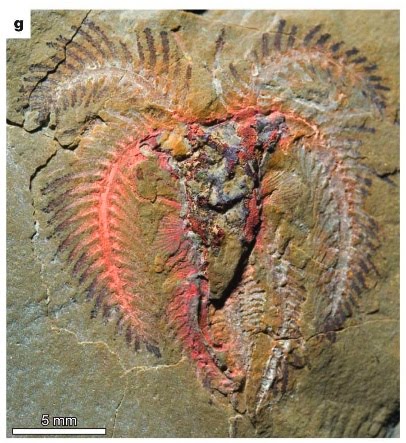
New fossil finds from Morocco's Fezouta Formations, however, shows that much of the Burgess Fauna in fact survived into the Lower Ordovician, which is the period that followed the Cambrian. This means that the apparent disappearance of the Burgess Fauna was mostly due to the difficulty of preserving soft tissue, and not their actual extinction. The picture above (which made the cover of Nature) shows an arthropod from Fezouta that resembles the Burgess arthropod Marrella which was among the fossils popularized by Stephen Jay Gould in his book about the Burgess Shale, Wonderful Life.

This find is significant because many of the fossils represent so-called 'stem groups'. Stem-group fossils are related to known groups of modern organisms but diverged from the lineage before the common ancestor of those modern species. Hence they can tell us facts about the early evolution of those groups that cannot be inferred from studying modern members alone. The persistence of Cambrian stem groups into the Ordovician may hence redraw our estimates for when some of the major branches of the animal tree of life diverged, and how animal life diversified during Earth's history.

Wednesday, April 02, 2008

Synchotron Radiation Tomography Illuminates Hidden Bugs

http://news.bbc.co.uk/2/hi/science/nature/7324564.stm

We've all seen pictures of ancient insects trapped in the golden, honey-like transparency of amber. Amber is fossilized tree resin, that when it was formed, trapped and preserved the form of insects and other small animals that it flowed over. But much amber is cloudy, and short of breaking it open, there's not been anyway to look inside to see what fossils might be found within. Now, scientists at the European Synchotron Radiation Facility in Grenoble, France have used high-intensity X-ray radiation to peek inside the amber and through computerized tomography (the same method as CT scans used in medicine) reconstructed 3-D images of fossils found in the amber. This was previously not possible with conventional X-ray sources. What's even neater - they use a method called 3D printing to produce a plastic resin scaled up model of the fossils in the amber, so palaeontologists have something tangible to manipulate and observe, rather than just pictures on a screen. Really amazing!

Tuesday, January 29, 2008

Horseshoe crabs now date back to 445 MYA

"A remarkable new fossil horseshoe crab, Lunataspis aurora gen. et sp. nov., from recently discovered Upper Ordovician (c. 445 Ma) shallow marine Konservat-Lagerstätten deposits in Manitoba (Canada)."

Lunatapsis aurora

See Rudkin, DM, GA Young & GS Nowlan, 2008. The oldest horseshoe crab: a new Xiphosurid from late Ordovician Konservat-Lagerstätten deposits in Manitoba, Canada. Palaeontology, 51(1): 1-9. and "Oldest Horseshoe Crab Fossil Discovered," by Jeanna Bryner. LiveScience.com, 28 Jan 2008.

This pushes back evidence for the mysterious horseshoe crabs by almost 100 million years, from 350 million to 445 million years ago. Having survived multiple extinction events during its geological existence, but habitat loss and marine pollution have seen significant localised loss of population numbers in some countries.

Wikimedia: Phanerozoic Biodiversity


Present day horseshoe crabs appear to be similar to such fossils and we refer to them as "living fossils". In Singapore, Mandai mangroves appear to be a significant refuge for them. Let's hope we can extend their impressive record a little longer.

Tuesday, January 01, 2008

Giant fungus

The Devonian fossil Prototaxites, long a puzzle thought to be a vascular tree species, may actually be a fungus.... C. Kevin Boyce of the University of Chicago and co-workers used isotopic ratios to show that it was more likely to be a heterotroph than an autotroph, and based on its anatomy it was most likely to have been a fungus.

Journal reference: Geology, May 2007; v. 35; no. 5; p. 399–402; doi: 10.1130/G23384A.1

Thursday, November 22, 2007

Giant Sea Scorpion!

We usually think of invertebrates as small animals, and arthropods in particular as being limited by the structural engineering of an exoskeleton, which is less capable of supporting large body sizes than an endoskeleton. A new fossil discovery however should creep out anyone who thinks that crabs and lobsters are already bigger than a decent invertebrate should be.

From a 43 cm long claw of the fossil eurypterid (sea scorpion) species Jaekelopterus rhenaniae found in Germany, researchers extrapolated the length of the animal's body to be between 233 to 259 cm, using claw size to body length ratios from other sea scorpinons. Eurypterids are members of the extinct subclass Eurypterida within the class Merostomata of the subphylum Chelicerata, i.e. they were chelicerates (like spiders and scorpions) most closely related to the horseshoe crabs.

Eurypterids were aquatic and the buoyancy conferred by water may help explain structurally their large size, but what about the problem of gaseous diffusion to tissues? They presumably had an open circulatory system like other arthropods which is less efficient than the closed circulation of vertebrates. The authors hypothesise that the higher oxygen levels in the atmosphere in the past could have helped them attain their large size, or that it was driven by an evolutionary arms race with their prey.

Some questions to think about:

  • Why is extrapolation using data from other sea scorpions a valid means of predicting the body length of the animal from only its claw?
  • Among the extant (still living) chelicerates, how do the methods of gas exchange differ between the aquatic and terrestrial groups?
  • What can we infer about its mode of feeding and possible prey?
  • How can we explain why such giant arthropods are no longer extant today?