Showing posts with label extinction. Show all posts

Saturday, January 26, 2013

Taxonomists are not going extinct

When talking to people studying biodiversity, one often hears that "taxonomists are a dying breed", an opinion that has been expressed on this blog before.

A newly-published meta-analysis looks at whether science can realistically finish cataloging all the world's biological species before they go extinct:
"Some people despair that most species will go extinct before they are discovered. However, such worries result from overestimates of how many species may exist, beliefs that the expertise to describe species is decreasing, and alarmist estimates of extinction rates. We argue that the number of species on Earth today is 5 ± 3 million, of which 1.5 million are named. New databases show that there are more taxonomists describing species than ever before, and their number is increasing faster than the rate of species description. Conservation efforts and species survival in secondary habitats are at least delaying extinctions. Extinction rates are, however, poorly quantified, ranging from 0.01 to 1% (at most 5%) per decade. We propose practical actions to improve taxonomic productivity and associated understanding and conservation of biodiversity."
They found that it's not true that taxonomists are a dying breed, but that the profession is undergoing a geographical shift from Western countries where modern taxonomy and big museum collections were first developed, to South America and Asia-Pacific countries. They argue that this is a good development because those are the countries where much of the world's biodiversity actually lies.

The number of active taxonomists was estimated by looking at databases to find out who is publishing new species descriptions. It's also not true that the current generation of taxonomists are mostly "one-hit wonders" who only describe one or two new species in their careers; there is not much difference between the previous and current generations of taxonomists in their productivity.

If we want to catalog all the world's biodiversity, declining lack of expertise is then not the problem. What's problematic is that even as we are still in a state of ignorance about the world's biodiversity, species are going extinct at a steady rate due to human activity. We are also victims of our own success: as more and more species have been described, it becomes harder to find new ones among the existing known diversity. It's like being stuck at home for the weekend: after you've read most of the books and watched most of the movies in your house, it's harder to find something new to do (at least before the Internet...).

But what's the point of all this taxonomic toil? Why describe new species? The questions of "how many species on Earth?" and "what is the extinction rate?" are notoriously difficult to answer. Whereas we now have a fair guess at the answer to the first question, estimates of the extinction rate vary widely, reflecting the huge uncertainties involved. As the authors point out: "Taxonomists are not in danger of extinction. They are increasing in numbers and will become more in demand as more species mean more diagnostic challenges to discriminate species, whether they are pests, pathogens, food, ecological keystone, or endangered species." This highlights how knowledge of biodiversity is important, both for its own sake and for the sake of human interests.

Thursday, November 17, 2011

Should conservationists give up?

According to the latest IUCN Red List, the Western Black Rhinoceros (Diceros bicornis longipes), a subspecies of the African Black Rhinoceros, is now extinct in the wild (IUCN website, NPR News). Closer to home, the Javan Rhinoceros is "making its last stand", being extinct outside of the island of Java. Although captive populations exist in zoos around the world, it is unlikely that they'll ever be reintroduced into the wild in a viable way.

This has made some conservationists wonder: is it even worth the trouble to try and save all these species?  They're not saying that we should give up entirely, but that we should set up a kind of conservation triage. "Triage" is a term which might be familiar to viewers of medical dramas on TV. It refers to sorting incoming patients according to their need for treatment and their possibility of survival. If resources are limited, care has to be parceled out, and we don't want to spend everything trying to save the ultimately unsavable. In this BBC News viewpoints article, we hear from the two sides of the triage debate.

I think that when the issue of conservation is framed in these terms, it really accentuates the different approaches to conservation, which in turn say something about why people want to save wildlife in the first place. Some people want to save landscapes in a holistic way, while others champion particular charismatic species.

If we had to choose which species to save, to "bring on the ark", so to speak, which ones would you bring? The most charismatic and aesthetically beautiful species may appeal to our human senses, but they need not be the keystone species that really hold the ecosystem together. In most cases, we don't even know enough about the ecology of a particular landscape to make that call.

In my opinion, ex situ conservation offers less return on investment than putting money into establishing reserves or policing existing ones. The Western Black Rhino did not go extinct because there weren't enough people who wanted to see it in zoos, but because of poaching in the wild. We can pull species out from the environment and keep them alive for a while, or maybe even a long time, but can we possibly hope to reassemble that ecosystem after everything has been wiped clean?

Take the unfortunate case of the land snail Powelliphanta augusta from New Zealand. It was discovered only in 1996 on a mountain ridge that was about to be cleared to make way for an open cast coal mine, and so 4000 individuals were caught and painstakingly relocated, 1600 being kept in refrigerated containers in a government conservation facility. What happened next is one of those things that really make you want to laugh even though it's sad, because of the sheer silliness of it:
Unfortunately, a fault in a sensor plunged the temperature in one of the units to zero, and 800 of the snails — a sizeable fraction of the entire species — froze to death. The fault was not noticed immediately because it happened over a public holiday.
The editorial in Nature that cites this episode calls for more "political will" to back conservation, but I think that this will has to be directed carefully.

I can't help but be reminded of tortoises when I think about captive breeding programs. The ethologist Konrad Lorenz, in one of his popular books, wrote that he wouldn't recommend turtles or tortoises as pets to the novice pet-keeper. Although they can survive for a long time under indifferent care, they're not really thriving. They just "slowly dying".

Things are not going to get better for captive-bred species. There probably won't be a happily-ever-after where they can be released to run free once again in their native habitats, because those habitats are on their way to being wiped out completely.  Perhaps it's time to put our efforts into saving habitats instead of collecting tortoises.

Sunday, September 25, 2011

Plant collecting and ex-situ conservation

Earlier this month I blogged about how beautiful wild orchids are under threat from indiscriminate plant collecting to satisfy the itch of orchid-fanciers to own the rarest and most delicate species in their gardens.

However, plant collecting does not always have a sad ending. The Victorian plant collectors who harvested rhododendrons and orchids in obscene quantity from the Himalayan uplands also ventured to other countries. In Japan, they came after the country ended its isolation from the West in 1854, and collected many species which found their way into British gardens and parks. Now, these same species are endangered in their native habitat, but relatively common in cultivation.

Preserving an endangered species outside its native environment is called ex-situ conservation. It's not ideal: they're largely removed from their natural interactions, the context is lost, and reintroducing them could be problematic, especially for animals with complex behaviors. Furthermore, only a few individuals can typically be preserved, so much of the genetic diversity is inevitably lost. However, with careful curation, like with the captive breeding programmes carried out in zoos, it is possible to minimize loss of genetic diversity in the existing captive gene pools and avoid inbreeding.

The article I linked to ends on a pessimistic note: all countries are having to deal with extinction of their native flora and fauna, to a greater or lesser extent. Ex-situ conservation can only help to a small extent, though anything is better than nothing at all.

In our anthropogenic age (what some people are calling the Anthropocene), with species being shuffled all over the globe and having their ways of life permanently changed, maybe it won't make sense to talk about native or non-native any more, except as a sort of historical documentation of what we have lost.

I'm not saying that tracts of the remaining "wild" nature are not worth preserving: the rain forests, taiga, and coral reefs are valuable for being as close to "native" as we can get. What I'm thinking of are the extreme cases of domesticated landscapes–much of old Europe, East Asia, and Mesopotamia–where any hope of reviving a pre-human species palette is impossible. Barring any great human cataclysm, the rest of the world will inevitably become more and more like these places over time.

Wednesday, September 29, 2010

Extinct species back to life - for now

Just as new species are being discovered, some extinct species occasionally do get rediscovered. A group led by Diana Fisher at the University of Queensland has surveyed rediscoveries of mammalian species thought to be extinct, among them the Guadalupe fur seal of Mexico and the Bahian tree rat of Brazil. Their conclusion? Stop wasting time by trying to look for charismatic, but dead-as-a-dodo, species like the Australian thylacine, and concentrate efforts on smaller, often well-concealed, species that are more likely to be alive.

Despite these rediscoveries, the news is not very hopeful, though. Most of these species persist as small populations in refugia which might eventually be destroyed because of clearing and land conversion. This piece of news by no means should be taken to mean that species are recovering, only that our knowledge of the natural world is incomplete, and this incompleteness extends to the extinct as much as it does to the extant.

Saturday, July 10, 2010

Lake Victoria Cichlids Coming Back...

The cichlid fishes of Lake Victoria in East Africa, the 2nd largest freshwater lake in the world, are famous for their diversity. They are a textbook example of adaptive radiation, that almost every student of evolution will have heard about. What they will also learn about, however, is that the cichlids are en route to extinction and depletion, because of the Nile Perch, a predatory fish introduced to the Lake in the 1960s for food and sport. In combination with eutrophication and pollution, cichlid populations and diversity declined considerably in the following decades.

Now, however, the populations may be recovering, according to scientists studying the lake. Part of the explanation lies in the heavy fishing pressure on the Nile Perch, and on improvements to the quality of water running into the lake, but the adaptive potential of the cichlid to changing conditions may have some role to play. Much of the research has been conducted by Ole Seehausen of Eawag Aquatic Research in Switzerland. His research had previously found that the increased turbidity of the lake impaired the ability of female fishes to discriminate the colors of their prospective mates, reducing the effectiveness of sexual selection and allowing more hybridization between previously reproductively-isolated species. As a result, the cichlid species in the lake today are of a very different composition and genetic makeup than those found before human modification of the lake environment.

Wednesday, May 19, 2010

Burgess Shale animals live(d) on...


The Burgess Shale is perhaps the iconic illustration of the Cambrian Explosion, which began 543 million years ago and saw the appearance of most modern animal body plans in the fossil record. What makes the Burgess Shale so important is its preservation of impressions of soft tissue, unlike most fossils which (unsurprisingly) represent only hard parts like shells and bones. After the Middle Cambrian, though, much of the soft-bodied Burgess fauna disappears.

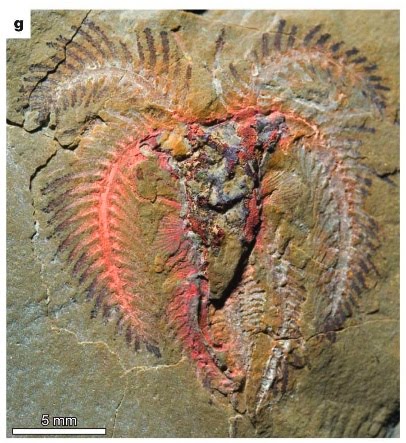
New fossil finds from Morocco's Fezouta Formations, however, shows that much of the Burgess Fauna in fact survived into the Lower Ordovician, which is the period that followed the Cambrian. This means that the apparent disappearance of the Burgess Fauna was mostly due to the difficulty of preserving soft tissue, and not their actual extinction. The picture above (which made the cover of Nature) shows an arthropod from Fezouta that resembles the Burgess arthropod Marrella which was among the fossils popularized by Stephen Jay Gould in his book about the Burgess Shale, Wonderful Life.

This find is significant because many of the fossils represent so-called 'stem groups'. Stem-group fossils are related to known groups of modern organisms but diverged from the lineage before the common ancestor of those modern species. Hence they can tell us facts about the early evolution of those groups that cannot be inferred from studying modern members alone. The persistence of Cambrian stem groups into the Ordovician may hence redraw our estimates for when some of the major branches of the animal tree of life diverged, and how animal life diversified during Earth's history.

Friday, May 07, 2010

Neaderthal Genome Sequenced

The Neanderthal genome has been sequenced, using high-throughput pyrosequencing technology, by a consortium largely based at the Max-Planck Institute for Evolutionary Anthropology in Germany.

They conclude from their analysis that Neanderthal and human populations diverged around 270,000 and 440,000 years ago, depending what age one accepts for the chimpanzee-human split. Also, they found that Neanderthals are closer to non-African (i.e. Eurasian) humans than Africans, suggesting that gene flow from Neanderthals to Eurasian humans occurred before the divergence of the Eurasian populations of humans.

The methods which they use to reduce contamination from non-Neanderthal DNA (human DNA which might be mistaken for Neanderthal, and bacterial which is in great abundance) are also very interesting, as is how they dealt with the problem of deamination of C nucleotides in ancient DNA.

What made me raise an eyebrow, though, is how Roche, the company which manufactures the 454 sequencing platform used in this project, sponsored the publicity campaign for this project. One would like to think that in science, the results which receive the most publicity are those which have the most scientific merit, but it may not always be so. In this case the interest of the subject matter is fairly obvious, but one needs to be wary of special interests and commercial agendas.

Thursday, September 24, 2009

HOME - Yann Arthus-Bertrand

HOME is a beautiful one and a half hour documentary by Yanns Arthus-Bertrand. Narrated by Glen Close, the story of how life began and how humans changed the environment as civilisation progress is beautifully told.

You can also watch it on YouTube.

skitched-20091224-090947.jpg

Tuesday, January 29, 2008

Horseshoe crabs now date back to 445 MYA

"A remarkable new fossil horseshoe crab, Lunataspis aurora gen. et sp. nov., from recently discovered Upper Ordovician (c. 445 Ma) shallow marine Konservat-Lagerstätten deposits in Manitoba (Canada)."

Lunatapsis aurora

See Rudkin, DM, GA Young & GS Nowlan, 2008. The oldest horseshoe crab: a new Xiphosurid from late Ordovician Konservat-Lagerstätten deposits in Manitoba, Canada. Palaeontology, 51(1): 1-9. and "Oldest Horseshoe Crab Fossil Discovered," by Jeanna Bryner. LiveScience.com, 28 Jan 2008.

This pushes back evidence for the mysterious horseshoe crabs by almost 100 million years, from 350 million to 445 million years ago. Having survived multiple extinction events during its geological existence, but habitat loss and marine pollution have seen significant localised loss of population numbers in some countries.

Wikimedia: Phanerozoic Biodiversity


Present day horseshoe crabs appear to be similar to such fossils and we refer to them as "living fossils". In Singapore, Mandai mangroves appear to be a significant refuge for them. Let's hope we can extend their impressive record a little longer.

Sunday, December 09, 2007

Deforestation in Brazil declining... or not?

The Brazilian government has announced a fall in the rate of deforestation in the Amazon for the third year running, ending July 2007. But environmental groups say that this is a 'past achievement' and that rates of deforestation are rising again. And as common sense will tell you, a fall in the rate of deforestation means that deforestation is still going on, just a bit slower.... Read more...

Thursday, November 22, 2007

Giant Sea Scorpion!

We usually think of invertebrates as small animals, and arthropods in particular as being limited by the structural engineering of an exoskeleton, which is less capable of supporting large body sizes than an endoskeleton. A new fossil discovery however should creep out anyone who thinks that crabs and lobsters are already bigger than a decent invertebrate should be.

From a 43 cm long claw of the fossil eurypterid (sea scorpion) species Jaekelopterus rhenaniae found in Germany, researchers extrapolated the length of the animal's body to be between 233 to 259 cm, using claw size to body length ratios from other sea scorpinons. Eurypterids are members of the extinct subclass Eurypterida within the class Merostomata of the subphylum Chelicerata, i.e. they were chelicerates (like spiders and scorpions) most closely related to the horseshoe crabs.

Eurypterids were aquatic and the buoyancy conferred by water may help explain structurally their large size, but what about the problem of gaseous diffusion to tissues? They presumably had an open circulatory system like other arthropods which is less efficient than the closed circulation of vertebrates. The authors hypothesise that the higher oxygen levels in the atmosphere in the past could have helped them attain their large size, or that it was driven by an evolutionary arms race with their prey.

Some questions to think about:

  • Why is extrapolation using data from other sea scorpions a valid means of predicting the body length of the animal from only its claw?
  • Among the extant (still living) chelicerates, how do the methods of gas exchange differ between the aquatic and terrestrial groups?
  • What can we infer about its mode of feeding and possible prey?
  • How can we explain why such giant arthropods are no longer extant today?

Wednesday, August 08, 2007

Yangtze River Dolphin extinct?

An intensive survey carried out to locate remaining individuals of the critically endangered Yangtze River Dolphin, or baiji, a freshwater dolphin endemic to that river and the only surviving representative of its family, has not been able to find any of the dolphins. According to IUCN criteria, however, this species cannot be formally classed as extinct because Red List rules stipulate that 50 years must have passed since the last verified sighting of the organism. However, very few surveys of such detail have been carried out for the Yangtze River Dolphin, so the IUCN Red List's entry on this dolphin is probably too optimistic in its estimates, and the baiji is probably either gone for good, or with too few numbers in the wild to survive for very much longer.

Numbers of baiji have always been low; estimates in the 1980s ranged from 100 - 400, with sightings of the animals usually in groups, but a more recent survey in 1997-9 sighted just over 20 individuals. This present survey covered the 1669 km length of the Yangtze between Yichang and Shanghai twice, using visual and acoustic methods. The authors point out that the baiji is primarily a victim of 'incidental mortality', unlike other recently extinct or endangered animals, such as the dodo and tiger, which are victims of hunting and trapping. What killed off the dolphin population was a combination of pollution and habitat degradation, as well as accidental killing from booming river shipping traffic and fishing activity.

The fact is that 'even large charismatic and nominally protected animals are still in grave danger of being lost', and just because an animal is on the Red List, is widely known, and is discussed at international meetings or in the media, doesn't mean that anything concrete is being done about its death and decline. In this respect it reminds me of the case of the Indian tiger and how its wild populations may have been systematically underestimated for years, while illegal poaching and trade in tiger parts has still persisted even in supposedly protected wildlife reserves. Furthermore, while the death of a big mammal is a tragic and dramatic wake-up call, it's clear that the extinctions that we're not aware of are still proceeding unabated and will continue to do so even if governments enforce conservation laws more strictly.

Reference: Turvey, S.T. et al. 2007. "First human-caused extinction of a cetacean species?" Biology Letters, 3(5): 537-540; published online: doi:10.1098/rsbl.2007.0292.

Friday, March 23, 2007

Indirect Dependence and Extinction

Something new that was highlighted in Science Daily:

Neighbors gone, sex gone, fruits gone, species gone. This is the ultra-short conclusion of the findings in a study by Dennis Hansen, Heine Kiesbüy, and Christine Müller from Zurich University, and Carl Jones from the Mauritian Wildlife Foundation, who found that an endangered plant in Mauritius depends on a neighboring plant to provide a safe home for its pollinator, a day-active gecko.