 |
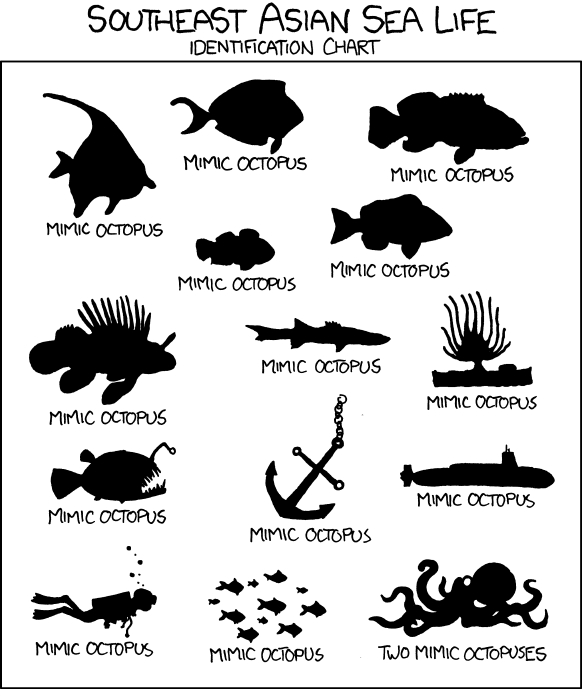
| From xkcd.com by Randall Munroe |
Showing posts with label crypsis. Show all posts
Showing posts with label crypsis. Show all posts
Monday, July 25, 2011
"Southeast Asian Sea Life" according to xkcd


Friday, November 26, 2010
Panthers and Leopards in the Malay Peninsula
The term 'panther' has a confusing history - it's been used to refer to any big, black (i.e. 'melanic') cat, usually the leopard in particular. Leopards and panthers used to be thought of as different species, but they are in fact merely different color variants, and this so-called melanic coat coloration is a recessive Mendelian trait. To complicate matters, the four big cats - leopards, tigers, lions, jaguars - have been grouped in the genus Panthera, based on the same etymological root.
In Southeast Asia, the leopard Panthera pardus exists in two color morphs: the usual spotted variety, and the melanic 'panthers'. However, a recent evaluation of camera-trap data could not find any spotted leopards South of the Isthmus of Kra; all the animals that were photographed by these traps were black leopards. Anecdotal evidence from interviews with aboriginal peoples living in national parks also found that they were unfamiliar with the spotted leopards but could recognize the black ones. Although 'absence of evidence is not evidence of absence', it does show that spotted leopards are at the very least rare in Malaysia. The authors of this study suggest that this trait has become genetically fixed because of a bottleneck event sometime in the history of this population. This is a neat intersection between basic natural history and genetics, having implications for the genetic variability of the Malayan leopards, and hence their conservation viability.
In Southeast Asia, the leopard Panthera pardus exists in two color morphs: the usual spotted variety, and the melanic 'panthers'. However, a recent evaluation of camera-trap data could not find any spotted leopards South of the Isthmus of Kra; all the animals that were photographed by these traps were black leopards. Anecdotal evidence from interviews with aboriginal peoples living in national parks also found that they were unfamiliar with the spotted leopards but could recognize the black ones. Although 'absence of evidence is not evidence of absence', it does show that spotted leopards are at the very least rare in Malaysia. The authors of this study suggest that this trait has become genetically fixed because of a bottleneck event sometime in the history of this population. This is a neat intersection between basic natural history and genetics, having implications for the genetic variability of the Malayan leopards, and hence their conservation viability.
Sunday, February 24, 2008
Secrets of cuttlefish camouflage
Secrets of the Camouflage Masters. Cuttlefish seem to be able to camouflage themselves against any sort of background - rocks and pebbles, corals, even checkerboards. Robert Hanlon of the Woods Hole Marine Biological Laboratory has classified the different cuttlefish camouflage patterns and shown that they fall into three broad categories - uniform colour, mottled colour, and disruptive patterns (like stripes and spots). According to the article: "What he learned from cephalopods may apply throughout the animal kingdom. The fact that cephalopods may need just three camouflage categories could mean that there are just a few basic ways to fool predators." That puts a new spin on the age old problem of animal camouflage and concealment. The question to ask might not be 'why are these animal so good at blending into the background' but rather 'why are we (or why are predators) so bad at spotting these particular kinds of patterns against the background?' A predator-centered approach might need to bring in theories of cognition and pattern-recognition.
One puzzling problem remains, though. Cuttlefish are colour blind yet they can adopt different colours in their camouflage. How do they manage to do so? No one yet knows....
One puzzling problem remains, though. Cuttlefish are colour blind yet they can adopt different colours in their camouflage. How do they manage to do so? No one yet knows....
Subscribe to:
Posts (Atom)