Scientists are not the only ones who are hunting for new species. Animal and plant collectors too, searching for new exotic species to add to their collections, pose a threat to the survival of newly-described species. They monitor the scientific literature for new species descriptions, which essentially tell them exactly where to pick up the loot and what it looks like!
That at least is the message of a new podcast from the BBC documentary series One Planet, titled "The New Species Dilemma" (mp3 download). New podcasts are available for 30 days after broadcast.
In some cases, though, scientists are aware of this problem. When the famous Wollemi Pine (which even has its own official website) was discovered in Australia, its location was not made publicly known, and I think that still is the case to this day.
At the same time, proper scientific description requires full documentation, and that includes geographical data. It's an unexpected problem, and I don't think something that most taxonomists have to think about. But if you're working on a particularly "charismatic" group of organisms (and standards for "charisma" vary; some people collect exotic frogs, for instance) it might be something worth giving some thought to!
Showing posts with label conservation. Show all posts
Showing posts with label conservation. Show all posts
Wednesday, March 07, 2012


Thursday, November 17, 2011
Should conservationists give up?
According to the latest IUCN Red List, the Western Black Rhinoceros (Diceros bicornis longipes), a subspecies of the African Black Rhinoceros, is now extinct in the wild (IUCN website, NPR News). Closer to home, the Javan Rhinoceros is "making its last stand", being extinct outside of the island of Java. Although captive populations exist in zoos around the world, it is unlikely that they'll ever be reintroduced into the wild in a viable way.
This has made some conservationists wonder: is it even worth the trouble to try and save all these species? They're not saying that we should give up entirely, but that we should set up a kind of conservation triage. "Triage" is a term which might be familiar to viewers of medical dramas on TV. It refers to sorting incoming patients according to their need for treatment and their possibility of survival. If resources are limited, care has to be parceled out, and we don't want to spend everything trying to save the ultimately unsavable. In this BBC News viewpoints article, we hear from the two sides of the triage debate.
I think that when the issue of conservation is framed in these terms, it really accentuates the different approaches to conservation, which in turn say something about why people want to save wildlife in the first place. Some people want to save landscapes in a holistic way, while others champion particular charismatic species.
If we had to choose which species to save, to "bring on the ark", so to speak, which ones would you bring? The most charismatic and aesthetically beautiful species may appeal to our human senses, but they need not be the keystone species that really hold the ecosystem together. In most cases, we don't even know enough about the ecology of a particular landscape to make that call.
In my opinion, ex situ conservation offers less return on investment than putting money into establishing reserves or policing existing ones. The Western Black Rhino did not go extinct because there weren't enough people who wanted to see it in zoos, but because of poaching in the wild. We can pull species out from the environment and keep them alive for a while, or maybe even a long time, but can we possibly hope to reassemble that ecosystem after everything has been wiped clean?
Take the unfortunate case of the land snail Powelliphanta augusta from New Zealand. It was discovered only in 1996 on a mountain ridge that was about to be cleared to make way for an open cast coal mine, and so 4000 individuals were caught and painstakingly relocated, 1600 being kept in refrigerated containers in a government conservation facility. What happened next is one of those things that really make you want to laugh even though it's sad, because of the sheer silliness of it:
I can't help but be reminded of tortoises when I think about captive breeding programs. The ethologist Konrad Lorenz, in one of his popular books, wrote that he wouldn't recommend turtles or tortoises as pets to the novice pet-keeper. Although they can survive for a long time under indifferent care, they're not really thriving. They just "slowly dying".
Things are not going to get better for captive-bred species. There probably won't be a happily-ever-after where they can be released to run free once again in their native habitats, because those habitats are on their way to being wiped out completely. Perhaps it's time to put our efforts into saving habitats instead of collecting tortoises.
This has made some conservationists wonder: is it even worth the trouble to try and save all these species? They're not saying that we should give up entirely, but that we should set up a kind of conservation triage. "Triage" is a term which might be familiar to viewers of medical dramas on TV. It refers to sorting incoming patients according to their need for treatment and their possibility of survival. If resources are limited, care has to be parceled out, and we don't want to spend everything trying to save the ultimately unsavable. In this BBC News viewpoints article, we hear from the two sides of the triage debate.
I think that when the issue of conservation is framed in these terms, it really accentuates the different approaches to conservation, which in turn say something about why people want to save wildlife in the first place. Some people want to save landscapes in a holistic way, while others champion particular charismatic species.
If we had to choose which species to save, to "bring on the ark", so to speak, which ones would you bring? The most charismatic and aesthetically beautiful species may appeal to our human senses, but they need not be the keystone species that really hold the ecosystem together. In most cases, we don't even know enough about the ecology of a particular landscape to make that call.
In my opinion, ex situ conservation offers less return on investment than putting money into establishing reserves or policing existing ones. The Western Black Rhino did not go extinct because there weren't enough people who wanted to see it in zoos, but because of poaching in the wild. We can pull species out from the environment and keep them alive for a while, or maybe even a long time, but can we possibly hope to reassemble that ecosystem after everything has been wiped clean?
Take the unfortunate case of the land snail Powelliphanta augusta from New Zealand. It was discovered only in 1996 on a mountain ridge that was about to be cleared to make way for an open cast coal mine, and so 4000 individuals were caught and painstakingly relocated, 1600 being kept in refrigerated containers in a government conservation facility. What happened next is one of those things that really make you want to laugh even though it's sad, because of the sheer silliness of it:
Unfortunately, a fault in a sensor plunged the temperature in one of the units to zero, and 800 of the snails — a sizeable fraction of the entire species — froze to death. The fault was not noticed immediately because it happened over a public holiday.The editorial in Nature that cites this episode calls for more "political will" to back conservation, but I think that this will has to be directed carefully.
I can't help but be reminded of tortoises when I think about captive breeding programs. The ethologist Konrad Lorenz, in one of his popular books, wrote that he wouldn't recommend turtles or tortoises as pets to the novice pet-keeper. Although they can survive for a long time under indifferent care, they're not really thriving. They just "slowly dying".
Things are not going to get better for captive-bred species. There probably won't be a happily-ever-after where they can be released to run free once again in their native habitats, because those habitats are on their way to being wiped out completely. Perhaps it's time to put our efforts into saving habitats instead of collecting tortoises.
Friday, October 07, 2011
World's largest shark sanctuary around Marshall Islands
The Marshall Islands (Wikipedia) are a remote country in the middle of the South Pacific, comprising a collection of islands and atolls and having a population of less than seventy thousand people. It's clear from the map below that its territory is mostly ocean.
That's what makes the recent announcement all the more significant. All 1,990,530 sq. km of its territorial waters will now become the world's largest shark sanctuary. This comes after the country enacted a moratorium on the shark trade in March of this year. According to the Pew Environment Group:
In related news from last month, Yao Ming, the famous Chinese basketball star, endorsed a renewed campaign against shark's fin soup in China (BBC News). This campaign is run by WildAid, an environmental NGO (press release). He's been associated with WildAid for at least the past five years (NY Times). As China becomes more affluent, demand for shark's fin is rising, but this raised awareness will hopefully help to counteract that.
An indication of how things could be going is in Hong Kong, where recent surveys have shown that attitudes towards serving and consuming shark's fin are changing. The Malaysian newspaper The Star has recently published a good article on the shark trade, including perspectives from those who are in the shark-processing industry.
That's what makes the recent announcement all the more significant. All 1,990,530 sq. km of its territorial waters will now become the world's largest shark sanctuary. This comes after the country enacted a moratorium on the shark trade in March of this year. According to the Pew Environment Group:
Key provisions of the comprehensive Marshall Islands' law include:
Read more at the Pew Environment website. Via Science and National Geographic.
- A complete prohibition on the commercial fishing of sharks as well as the sale of any sharks or shark products. Its zero retention stipulation requires that any shark caught accidentally by fishing vessels must be set free.
- Large monetary fines, anywhere between US$25,000 to US$200,000, for anyone who is found to be fishing sharks or in possession of shark fins. In addition, violators would be fined the market value of the product in their possession.
- A ban on the use of wire leaders, a longline fishing gear which is among the most lethal to sharks.
- A monitoring and enforcement provision which requires all fishing vessels to land their catch at one of the country's ports and bans at sea transfers.
In related news from last month, Yao Ming, the famous Chinese basketball star, endorsed a renewed campaign against shark's fin soup in China (BBC News). This campaign is run by WildAid, an environmental NGO (press release). He's been associated with WildAid for at least the past five years (NY Times). As China becomes more affluent, demand for shark's fin is rising, but this raised awareness will hopefully help to counteract that.
 |
| Poster of Yao Ming by WildAid. From Bush Warriors blog |
An indication of how things could be going is in Hong Kong, where recent surveys have shown that attitudes towards serving and consuming shark's fin are changing. The Malaysian newspaper The Star has recently published a good article on the shark trade, including perspectives from those who are in the shark-processing industry.
Sunday, September 25, 2011
Plant collecting and ex-situ conservation
Earlier this month I blogged about how beautiful wild orchids are under threat from indiscriminate plant collecting to satisfy the itch of orchid-fanciers to own the rarest and most delicate species in their gardens.
However, plant collecting does not always have a sad ending. The Victorian plant collectors who harvested rhododendrons and orchids in obscene quantity from the Himalayan uplands also ventured to other countries. In Japan, they came after the country ended its isolation from the West in 1854, and collected many species which found their way into British gardens and parks. Now, these same species are endangered in their native habitat, but relatively common in cultivation.
Preserving an endangered species outside its native environment is called ex-situ conservation. It's not ideal: they're largely removed from their natural interactions, the context is lost, and reintroducing them could be problematic, especially for animals with complex behaviors. Furthermore, only a few individuals can typically be preserved, so much of the genetic diversity is inevitably lost. However, with careful curation, like with the captive breeding programmes carried out in zoos, it is possible to minimize loss of genetic diversity in the existing captive gene pools and avoid inbreeding.
The article I linked to ends on a pessimistic note: all countries are having to deal with extinction of their native flora and fauna, to a greater or lesser extent. Ex-situ conservation can only help to a small extent, though anything is better than nothing at all.
In our anthropogenic age (what some people are calling the Anthropocene), with species being shuffled all over the globe and having their ways of life permanently changed, maybe it won't make sense to talk about native or non-native any more, except as a sort of historical documentation of what we have lost.
I'm not saying that tracts of the remaining "wild" nature are not worth preserving: the rain forests, taiga, and coral reefs are valuable for being as close to "native" as we can get. What I'm thinking of are the extreme cases of domesticated landscapes–much of old Europe, East Asia, and Mesopotamia–where any hope of reviving a pre-human species palette is impossible. Barring any great human cataclysm, the rest of the world will inevitably become more and more like these places over time.
However, plant collecting does not always have a sad ending. The Victorian plant collectors who harvested rhododendrons and orchids in obscene quantity from the Himalayan uplands also ventured to other countries. In Japan, they came after the country ended its isolation from the West in 1854, and collected many species which found their way into British gardens and parks. Now, these same species are endangered in their native habitat, but relatively common in cultivation.
Preserving an endangered species outside its native environment is called ex-situ conservation. It's not ideal: they're largely removed from their natural interactions, the context is lost, and reintroducing them could be problematic, especially for animals with complex behaviors. Furthermore, only a few individuals can typically be preserved, so much of the genetic diversity is inevitably lost. However, with careful curation, like with the captive breeding programmes carried out in zoos, it is possible to minimize loss of genetic diversity in the existing captive gene pools and avoid inbreeding.
The article I linked to ends on a pessimistic note: all countries are having to deal with extinction of their native flora and fauna, to a greater or lesser extent. Ex-situ conservation can only help to a small extent, though anything is better than nothing at all.
In our anthropogenic age (what some people are calling the Anthropocene), with species being shuffled all over the globe and having their ways of life permanently changed, maybe it won't make sense to talk about native or non-native any more, except as a sort of historical documentation of what we have lost.
I'm not saying that tracts of the remaining "wild" nature are not worth preserving: the rain forests, taiga, and coral reefs are valuable for being as close to "native" as we can get. What I'm thinking of are the extreme cases of domesticated landscapes–much of old Europe, East Asia, and Mesopotamia–where any hope of reviving a pre-human species palette is impossible. Barring any great human cataclysm, the rest of the world will inevitably become more and more like these places over time.
Friday, September 02, 2011
Perils of beauty - Attack of the "Orchid snatchers"
Collectors of rare orchids are stripping them from the rainforest, driving the most beautiful and unique species to rapid extinction. Is beauty a curse? Perhaps so, if you're an orchid!
This is nothing new, of course. Even the Victorian Britons suffered the same collecting-mania, which they called "orchidelirium". The period saw a fashion for hothouses among the wealthy, and professional plant-collectors were despatched to far-flung parts of the world to procure new and interesting plants for horticulture. This is the subject of a book, The Plant Hunters, by Tyler Whittle.
Eminent botanists were not innocent parties either:
The BBC article cites the case of a new orchid species, Bulbophyllum kubahense, that was introduced into the black market even before its discoverer, the orchidologist Jaap Vermeulen, had even published the formal description in a botanical journal.
All orchids are in Appendix II of the CITES treaty (see list - scroll down), which means that permits are required for them to be exported. A number of rare species, including all the slipper-orchids (Paphiopedilium) are Appendix I species, where trade in wild-caught individuals is illegal except with special permits.
Monitoring the trade and policing the rainforest is a mammoth task, which perhaps can never be fully accomplished. The only hope may lie in cutting back demand. Most orchids on sale in garden shops are artificially propagated, with Singapore having played a major role in the development of orchid propagation techniques. Nonetheless, for the conscientious shopper, it is probably worth paying more attention to the provenance of your garden plants before buying them, just as people are paying attention to the provenance of the fish they eat and the coffee they drink.
This is nothing new, of course. Even the Victorian Britons suffered the same collecting-mania, which they called "orchidelirium". The period saw a fashion for hothouses among the wealthy, and professional plant-collectors were despatched to far-flung parts of the world to procure new and interesting plants for horticulture. This is the subject of a book, The Plant Hunters, by Tyler Whittle.
Eminent botanists were not innocent parties either:
"Sir Joseph Hooker, traveling in India, remarks that Vanda caerulea is 'The rarest and most beautiful of Indian orchids'. Yet in a footnote he mentions that he collected 'seven men's loads' of this plant (few of which reached England alive); he goes on to suggest that collectors with better facilities for getting the plants home 'might easily clear from £2,000 to £3,000 in one season, by the sale of Khasia orchids' - and this is just what happened. ... Few orchids now remain in the Himalayan foothills."This is quoted from Anthony Huxley's very readable book Green Inheritance: The WWF Book of Plants, originally published in 1984 but still a good source of information about the ways people make use of plants and relate to our green environment.
The BBC article cites the case of a new orchid species, Bulbophyllum kubahense, that was introduced into the black market even before its discoverer, the orchidologist Jaap Vermeulen, had even published the formal description in a botanical journal.
All orchids are in Appendix II of the CITES treaty (see list - scroll down), which means that permits are required for them to be exported. A number of rare species, including all the slipper-orchids (Paphiopedilium) are Appendix I species, where trade in wild-caught individuals is illegal except with special permits.
Monitoring the trade and policing the rainforest is a mammoth task, which perhaps can never be fully accomplished. The only hope may lie in cutting back demand. Most orchids on sale in garden shops are artificially propagated, with Singapore having played a major role in the development of orchid propagation techniques. Nonetheless, for the conscientious shopper, it is probably worth paying more attention to the provenance of your garden plants before buying them, just as people are paying attention to the provenance of the fish they eat and the coffee they drink.
Thursday, August 04, 2011
Immigration and invasion - biological xenophobia?
One of the hottest political topics in Singapore today is the issue of immigration: your 'foreign talent' may be my 'job-stealer', as the debate continues on just how much immigration is desirable for a small country like ours.
In the field of biological conservation, a similar conflict has popped up, as reported recently in the Boston Globe. Conservationists have traditionally spoken of 'introduced' vs. 'native' species, with the least desirable introduced species being termed 'invasive'. But a number of vocal critics have spoken up to say that this is simply nativism - an unthinking bias in favour of the supposedly native. They contend that the division between native and non-native is arbitrary and unscientific, in part because many familiar species were originally imports from elsewhere, and also because the environment is constantly changing, and species are continually migrating, and to try to freeze a community in time is akin to gardening nature. The author Michael Pollan went as far as to say that species-nativism was "xenophobic".
Classical examples of species invasions include the rabbit and cane toad in Australia, and the European starling in the USA (for which Shakespeare, bizarrely enough, is to blame). In Singapore, Clidemia hirta or Koster's Curse (a native of the Americas) has a tenacious foothold on forest fringes and clearings, preventing the re-establishment of native vegetation.
However, much of our modern landscape is precisely the product of introduced species. The grand arching wayside tree canopies that provide shade and shelter are often rain trees, Samanea saman, which are native to Brazil. These are perhaps the 'foreign talent' side of the argument.
We justifiably take pride in our native species, and among the popular Science Centre guidebook series is a volume on cultivating native plant species. But for an island as small as Singapore, does it make sense to speak of 'native' species? What hope is there of eradicating non-native species, anyway?
Ultimately, it may simply be a matter of rhetoric. The disagreement is not over the substance of the matter but the language that we use to talk about it. As the Globe article says:
In the field of biological conservation, a similar conflict has popped up, as reported recently in the Boston Globe. Conservationists have traditionally spoken of 'introduced' vs. 'native' species, with the least desirable introduced species being termed 'invasive'. But a number of vocal critics have spoken up to say that this is simply nativism - an unthinking bias in favour of the supposedly native. They contend that the division between native and non-native is arbitrary and unscientific, in part because many familiar species were originally imports from elsewhere, and also because the environment is constantly changing, and species are continually migrating, and to try to freeze a community in time is akin to gardening nature. The author Michael Pollan went as far as to say that species-nativism was "xenophobic".
Classical examples of species invasions include the rabbit and cane toad in Australia, and the European starling in the USA (for which Shakespeare, bizarrely enough, is to blame). In Singapore, Clidemia hirta or Koster's Curse (a native of the Americas) has a tenacious foothold on forest fringes and clearings, preventing the re-establishment of native vegetation.
However, much of our modern landscape is precisely the product of introduced species. The grand arching wayside tree canopies that provide shade and shelter are often rain trees, Samanea saman, which are native to Brazil. These are perhaps the 'foreign talent' side of the argument.
We justifiably take pride in our native species, and among the popular Science Centre guidebook series is a volume on cultivating native plant species. But for an island as small as Singapore, does it make sense to speak of 'native' species? What hope is there of eradicating non-native species, anyway?
Ultimately, it may simply be a matter of rhetoric. The disagreement is not over the substance of the matter but the language that we use to talk about it. As the Globe article says:
Just as most ecologists accept that only a fraction of non-native species are harmful, the anti-nativists, when pressed, will admit that unequivocally destructive species like the Asian longhorned beetle should be reined in. Their disagreement lies more in how we should talk about the issue, how we justify our interventions and how we label the species we want to eradicate.That is to say: when we call a species an 'invasive species', it's not enough simply to say that it's non-native and hence must be eradicated for that reason alone. We must be clearer about what 'invasiveness' means, and be able to justify our assertions about their harmfulness and undesirability.
Sunday, July 31, 2011
Work on Bukit Timah Eco-Link begins
Two years ago, Cheng Puay blogged about the announcement of an ecological 'bridge' to be built across the Bukit Timah Expressway (BKE) to connect Bukit Timah Nature Reserve and the Central Catchment area. Construction of the BKE 25 years ago had caused the two forested areas to be separated from each other, preventing animals from moving freely and making them run the risk of becoming roadkill.
Today the Straits Times reported that work on the Eco-Link@BKE has finally begun, at a projected cost of $17 million, to be completed around December 2013. It will certainly be an exciting experiment to see whether man-made forest corridors of this sort can be effective at allowing migration and genetic exchange between two forest fragments.
Incidentally, the previous blog post is the most often-visited post on this blog. Those who have read that article may hence be glad to have this update.
In other news, the ST today also reported on a growing poaching problem in forested areas around Singapore, including wild boar traps which have inadvertently maimed stray dogs. Nature aficionados who habitually walk through the undergrowth should watch out!
Today the Straits Times reported that work on the Eco-Link@BKE has finally begun, at a projected cost of $17 million, to be completed around December 2013. It will certainly be an exciting experiment to see whether man-made forest corridors of this sort can be effective at allowing migration and genetic exchange between two forest fragments.
Incidentally, the previous blog post is the most often-visited post on this blog. Those who have read that article may hence be glad to have this update.
In other news, the ST today also reported on a growing poaching problem in forested areas around Singapore, including wild boar traps which have inadvertently maimed stray dogs. Nature aficionados who habitually walk through the undergrowth should watch out!
Friday, June 24, 2011
Indigenous peoples opposed to Indonesian carbon swap
Forest-dwelling communities in the Indonesian state of Kalimantan, on the island of Borneo, have expressed their objection to the REDD (Reducing Emissions from Deforestation and Degradation) agreements signed by Indonesia with other countries and non-governmental groups.
REDD schemes are designed to put an economic value on forested lands for biodiversity and ecosystems services, where previously the only ways to extract monetary value from them were logging and clearing land for agriculture. Under such schemes, many of which are bilateral, governments are paid money in exchange for preserving tracts of forest. (Example: UN-REDD programme in Indonesia)
To quote a forest reserve executive in Guyana: "We have a resource we would like to get money for. Either you pay us for biodiversity services or we will sell the forest to Malaysian logging companies." (source)
Indigenous peoples who claim customary use of forests have objected to them because they feel that their rights to the land have been overlooked in the process, displacing them from their livelihood and dwellings. It seems like there may be more than one indigenous organization making public statements against REDD programmes.
I've previously blogged about how deforested land is being 'swept under the carpet' due to poor oversight. Related concerns have been expressed about the tremendous potential for corruption that they bring. It seems obvious to state that corruption is possible when large sums of money are being given to a central government to pay for a rural commodity (ecosystem services) which is hard to define and which you can't take conventional delivery of.
REDD schemes are designed to put an economic value on forested lands for biodiversity and ecosystems services, where previously the only ways to extract monetary value from them were logging and clearing land for agriculture. Under such schemes, many of which are bilateral, governments are paid money in exchange for preserving tracts of forest. (Example: UN-REDD programme in Indonesia)
To quote a forest reserve executive in Guyana: "We have a resource we would like to get money for. Either you pay us for biodiversity services or we will sell the forest to Malaysian logging companies." (source)
Indigenous peoples who claim customary use of forests have objected to them because they feel that their rights to the land have been overlooked in the process, displacing them from their livelihood and dwellings. It seems like there may be more than one indigenous organization making public statements against REDD programmes.
I've previously blogged about how deforested land is being 'swept under the carpet' due to poor oversight. Related concerns have been expressed about the tremendous potential for corruption that they bring. It seems obvious to state that corruption is possible when large sums of money are being given to a central government to pay for a rural commodity (ecosystem services) which is hard to define and which you can't take conventional delivery of.
Thursday, February 10, 2011
Highlights of the Week: Catching up on Blogging
It's been a while since I've written anything new, and the explanation is straightforward: classes just started up again and have hit me like a freight train. Two weeks in, I've just had a chance to catch my breath.
But I've still been keeping an eye out for interesting articles and news on the Web, and here's my selection of cool stuff from the past week (okay, two weeks...):
Green Porno film star and director talks about her work. Isabella Rossellini's short film series, Green Porno and its follow-up Seduce Me ("A potential sponsor called to say they liked the films but that they couldn't support anything that had the word "porno" in it") are short (1-2 mins), award-winning gems about the peculiar sex lives of different animals. She stars in all of them as the animals, dressing up in fantastic paper costumes (see above).
Vladimir Nabokov's biogeographic theory on the origin of the Polyommatus blues butterflies has been confirmed by lepidopterists using molecular techniques. Aside from being a successful author in both his native Russian and his adopted English (in which he wrote his most famous book, Lolita), he was a great butterfly enthusiast and was for a time curator of Lepidoptera in Harvard's Museum of Comparative Zoology.
Woodpecker skulls inspire the design of more effective shock absorbers. Fun fact: woodpecker skulls decelerate by up to 1200 g each time it hammers (more than 20 times a second!), whereas humans would be concussed by an acceleration/deceleration between 80-100 g.
World Wildlife Foundation launches a new document format, similar to Adobe's PDF format, but which doesn't allow the document to be printed, to raise awareness about excessive paper use. As expected, the file extension is .wwf. Good idea, or gimmick?
The Galapagos Islands, biodiversity hotspot and inspiration for Darwin's theory of evolution, have been taken off UNESCO's list of endangered World Heritage Sites. Doesn't mean that they're out of danger, though. Ironically, the effects of tourism are the greatest threats to the islands today, as the booming tourist industry encourages development and immigration to the archipelago.
Photo gallery of the world's 10 most threatened rainforests, including Sundaland, the Philippines, and India-Burma.
But I've still been keeping an eye out for interesting articles and news on the Web, and here's my selection of cool stuff from the past week (okay, two weeks...):
Green Porno film star and director talks about her work. Isabella Rossellini's short film series, Green Porno and its follow-up Seduce Me ("A potential sponsor called to say they liked the films but that they couldn't support anything that had the word "porno" in it") are short (1-2 mins), award-winning gems about the peculiar sex lives of different animals. She stars in all of them as the animals, dressing up in fantastic paper costumes (see above).
Vladimir Nabokov's biogeographic theory on the origin of the Polyommatus blues butterflies has been confirmed by lepidopterists using molecular techniques. Aside from being a successful author in both his native Russian and his adopted English (in which he wrote his most famous book, Lolita), he was a great butterfly enthusiast and was for a time curator of Lepidoptera in Harvard's Museum of Comparative Zoology.
Woodpecker skulls inspire the design of more effective shock absorbers. Fun fact: woodpecker skulls decelerate by up to 1200 g each time it hammers (more than 20 times a second!), whereas humans would be concussed by an acceleration/deceleration between 80-100 g.
World Wildlife Foundation launches a new document format, similar to Adobe's PDF format, but which doesn't allow the document to be printed, to raise awareness about excessive paper use. As expected, the file extension is .wwf. Good idea, or gimmick?
The Galapagos Islands, biodiversity hotspot and inspiration for Darwin's theory of evolution, have been taken off UNESCO's list of endangered World Heritage Sites. Doesn't mean that they're out of danger, though. Ironically, the effects of tourism are the greatest threats to the islands today, as the booming tourist industry encourages development and immigration to the archipelago.
Photo gallery of the world's 10 most threatened rainforests, including Sundaland, the Philippines, and India-Burma.
Thursday, January 13, 2011
Wilderness Parks May Change Beyond Recognition
Climate change may cause changes to national parks in the US that will alter their very identity, according to scientists and conservationists interviewed by Nature magazine. It's not all about glaciers melting, either. Warm winters in the past few years have allowed populations of the mountain pine beetle to boom in Yellowstone National Park, where they previously were kept in check by winter cold. As a result, stands of dead trees killed by the beetle, which bores into the wood of living trees, are now a common sight. Park managers and conservationists
It's an unrealistic idealization because there's really nothing that has escaped the human hand, being only a matter of degrees. Environmental historian William Cronon reflects on this in a thought-provoking 1995 essay entitled "The Trouble with Wilderness; or Getting Back to the Wrong Nature" (reprinted 2005 in Guernica magazine).
The concern about the fate of Yellowstone and other iconic American parks reminds me of a research talk I attended a long time ago; unfortunately I can't remember who gave it and when. It was about the gazetting of marine reserves, and the speaker pointed out that the fact of accelerated climate change meant that our intuitions about what to preserve are often wrong. Instead of drawing park boundaries only around the prominent patch of pristine reefs, which with rising temperatures and bleaching will eventually become an ugly dead zone, we should include in large part those areas which are less picture-perfect, but which contain communities which are more robust to change and which the future ecosystem will still rely upon.
The overall message is that we can no longer afford to think of nature as 'timeless', especially with the prospect of further anthropogenic change.
"... are coming to terms with the idea that the historical remit of most parks systems — to preserve a piece of land in its 'natural' state — is untenable. 'You can't fight the climate,' says Ken Aho, an ecologist at Idaho State University in Pocatello, who studies non-native species at Yellowstone National Park in Wyoming. 'Eventually you have to throw up your hands,' he says."Aldo Leopold, author of A Sand County Almanac, and an influential pioneer of wildlife management in America, opined that "a national park should represent a vignette of primitive America." On the other hand, the very idea of an "untouched wilderness", as something apart from human civilization, and to which we should have recourse when we wish to seek Nature (with a capital N), is a recent invention.
It's an unrealistic idealization because there's really nothing that has escaped the human hand, being only a matter of degrees. Environmental historian William Cronon reflects on this in a thought-provoking 1995 essay entitled "The Trouble with Wilderness; or Getting Back to the Wrong Nature" (reprinted 2005 in Guernica magazine).
The concern about the fate of Yellowstone and other iconic American parks reminds me of a research talk I attended a long time ago; unfortunately I can't remember who gave it and when. It was about the gazetting of marine reserves, and the speaker pointed out that the fact of accelerated climate change meant that our intuitions about what to preserve are often wrong. Instead of drawing park boundaries only around the prominent patch of pristine reefs, which with rising temperatures and bleaching will eventually become an ugly dead zone, we should include in large part those areas which are less picture-perfect, but which contain communities which are more robust to change and which the future ecosystem will still rely upon.
The overall message is that we can no longer afford to think of nature as 'timeless', especially with the prospect of further anthropogenic change.
Monday, January 10, 2011
Dolphins for Sentosa Resort Moved to Philippines?
The proposed Marine Life Park run by Resorts World Sentosa (RWS) has come under fire for its planned dolphin show ever since word about it got out to the public. The dolphins were captured from the wild in the Solomon Islands and shipped first to the Philippines then to Langkawi, where they have been held for training.
Last October, two (out of seven) were reported to have died from a bacterial infection. In the last month, they have been moved again. According to Today Online:
In reply, a member of the public claims that having "dolphins and whales in captivity is not about education or conservation, it is about one thing - profit,"and that the best place to learn from them is in their natural habitat.
Now that nature documentaries have become so advanced both in technical terms and in narrative sophistication, I think that one would learn more from watching a good film about the life and behavior of dolphins, filmed in the wild with wild animals, than from paying to see a handful of caged animals performing tricks. I'm not saying that zoos don't have value; what I have in mind are rare animals whose beauty and fascination lie as much in their behavior and interactions with their natural environment as with their physical appearance. Dolphins certainly fall in this category.
Last October, two (out of seven) were reported to have died from a bacterial infection. In the last month, they have been moved again. According to Today Online:
An employee who wanted to be known as Ahmed, told MediaCorp that the dolphins were put into a container last month and sent to Langkawi's international airport, from where they shipped to the Philippines.RWS has defended its decision to have a dolphin display by saying that it complied with CITES regulations on the trafficking of endangered species, and that the display would be "educating the public on marine life and environmental issues."
In reply, a member of the public claims that having "dolphins and whales in captivity is not about education or conservation, it is about one thing - profit,"and that the best place to learn from them is in their natural habitat.
Now that nature documentaries have become so advanced both in technical terms and in narrative sophistication, I think that one would learn more from watching a good film about the life and behavior of dolphins, filmed in the wild with wild animals, than from paying to see a handful of caged animals performing tricks. I'm not saying that zoos don't have value; what I have in mind are rare animals whose beauty and fascination lie as much in their behavior and interactions with their natural environment as with their physical appearance. Dolphins certainly fall in this category.
Monday, December 13, 2010
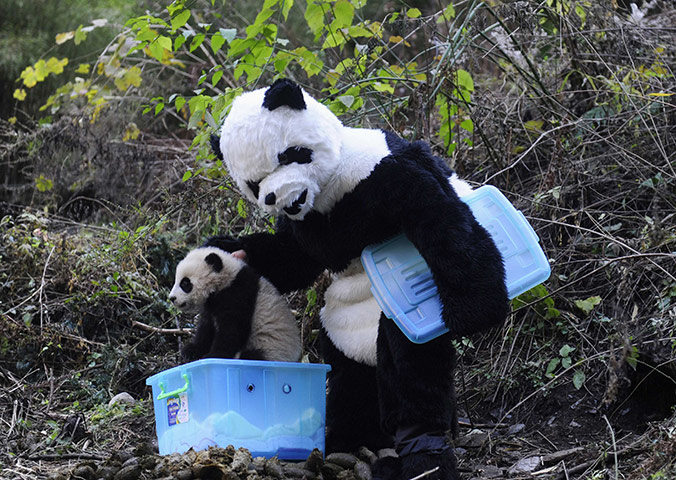
Can you fool a baby panda?
 |
| Source: Reuters, via The Guardian |
How effective is this? Only time will tell. In the meanwhile, enjoy the bizarre photographs....
Friday, December 10, 2010
"Green Energy" sometimes a different kind of green
"Green Energy" is a buzzword in policy circles because what is "green" must be good for the environment, right? Unfortunately, the truth is that what sounds like a good idea on paper (or increasingly, online) can actually do more harm than good.
The advocacy group Survival International, which claims to represent the interests of "tribal peoples" around the world, has criticized the Malaysian Bakun dam project in Borneo, which not only has flooded large tracts of rainforest and disrupted river flow, but also has displaced members of the Penan tribe. They also have sharp words for the palm oil plantations which are razing forest in the name of biofuel, a subject which this blog has covered many times before. As one commentator on the Malaysia Today website (where the SI article is reposted) remarks, the only thing "green" about these projects is the money changing hands!
The advocacy group Survival International, which claims to represent the interests of "tribal peoples" around the world, has criticized the Malaysian Bakun dam project in Borneo, which not only has flooded large tracts of rainforest and disrupted river flow, but also has displaced members of the Penan tribe. They also have sharp words for the palm oil plantations which are razing forest in the name of biofuel, a subject which this blog has covered many times before. As one commentator on the Malaysia Today website (where the SI article is reposted) remarks, the only thing "green" about these projects is the money changing hands!
Monday, November 29, 2010
Indonesian forest plan under threat?
Indonesia is a testbed for so-called 'cash for carbon' plans (Reduced Emissions from Deforestation and Forest Degradation, or REDD), where developing countries are given credits for reducing deforestation; this not only preserves valuable forest habitat for wildlife, but curbs carbon emissions from deforestation itself.
Greenpeace, however, has released a report that says Indonesia is planning to go ahead with massive forest clearance despite signing a new REDD agreement with Norway. According to the New York Times's coverage:
Tremendous disappointment, or 'more of the same'? How Indonesia handles this will certainly be watched closely. As with any current event it runs the risk of being swept under the carpet, or just sat upon until the media attention inevitably dissipates.
More coverage:
Greenpeace, however, has released a report that says Indonesia is planning to go ahead with massive forest clearance despite signing a new REDD agreement with Norway. According to the New York Times's coverage:
Greenpeace said that government documents show plans to bring 63 million hectares, or nearly 156 million acres, of land into production by 2030, including 80 percent of its peatland and half its forested orangutan habitat, to support expansion of industries including pulp, paper and palm oil.
At the same time, the group said, a push is on to rebrand the clearing of forests for plantations (which results in a net release of carbon into the atmosphere) as the replacement of degraded land with new trees (which takes carbon out of the atmosphere). This, they say, could effectively mean international funds would be subsidizing forest destruction.
Tremendous disappointment, or 'more of the same'? How Indonesia handles this will certainly be watched closely. As with any current event it runs the risk of being swept under the carpet, or just sat upon until the media attention inevitably dissipates.
More coverage:
- Greenpeace's original report, titled 'Protection Money'.
- Blogger Chris Lang in REDD-Monitor gives a brief account of recent REDD-related developments in Indonesia.
- The REDD-ALERT website describing various REDD initiatives around the world.
Friday, November 26, 2010
Panthers and Leopards in the Malay Peninsula
The term 'panther' has a confusing history - it's been used to refer to any big, black (i.e. 'melanic') cat, usually the leopard in particular. Leopards and panthers used to be thought of as different species, but they are in fact merely different color variants, and this so-called melanic coat coloration is a recessive Mendelian trait. To complicate matters, the four big cats - leopards, tigers, lions, jaguars - have been grouped in the genus Panthera, based on the same etymological root.
In Southeast Asia, the leopard Panthera pardus exists in two color morphs: the usual spotted variety, and the melanic 'panthers'. However, a recent evaluation of camera-trap data could not find any spotted leopards South of the Isthmus of Kra; all the animals that were photographed by these traps were black leopards. Anecdotal evidence from interviews with aboriginal peoples living in national parks also found that they were unfamiliar with the spotted leopards but could recognize the black ones. Although 'absence of evidence is not evidence of absence', it does show that spotted leopards are at the very least rare in Malaysia. The authors of this study suggest that this trait has become genetically fixed because of a bottleneck event sometime in the history of this population. This is a neat intersection between basic natural history and genetics, having implications for the genetic variability of the Malayan leopards, and hence their conservation viability.
In Southeast Asia, the leopard Panthera pardus exists in two color morphs: the usual spotted variety, and the melanic 'panthers'. However, a recent evaluation of camera-trap data could not find any spotted leopards South of the Isthmus of Kra; all the animals that were photographed by these traps were black leopards. Anecdotal evidence from interviews with aboriginal peoples living in national parks also found that they were unfamiliar with the spotted leopards but could recognize the black ones. Although 'absence of evidence is not evidence of absence', it does show that spotted leopards are at the very least rare in Malaysia. The authors of this study suggest that this trait has become genetically fixed because of a bottleneck event sometime in the history of this population. This is a neat intersection between basic natural history and genetics, having implications for the genetic variability of the Malayan leopards, and hence their conservation viability.
Monday, November 01, 2010
Singapore Index on Cities' Biodiversity endorsed in Nagoya
The Straits Times reports that the Singapore Index on Cities' Biodiversity (CBI) has been endorsed at a meeting of the Convention on Biological Diversity (CBD) in Nagoya. This index is a 'scorecard' for cities, rating them on the basis of several criteria which account for the extent of their remaining native biodiversity, ecosystem services, education and recreational value, and governance/management of biodiversity. Singapore's National Parks Board (NParks) played a key role in formulating this index for the CBD.
Further information: Singapore Index webpage at CBD, NParks website
Further information: Singapore Index webpage at CBD, NParks website
Saturday, October 09, 2010
Like maps? Help map IUCN Red List data
 |
| Distribution of the Spanish Ibex, drawn from IUCN data. (Source: By Nrg800 [CC-BY-SA-3.0 or GFDL], from Wikimedia Commons) |
![By Nrg800 [CC-BY-SA-3.0 or GFDL], from Wikimedia Commons](http://commons.wikimedia.org/wiki/File:Spanish_Ibex.jpg)

If you've always wanted to do something with GIS (geographic information systems) but needed data to make pretty maps with, why not help draw species distribution maps for Wikimedia Commons? The International Union for the Conservation of Nature (IUCN) has partnered with Wikimedia to put the species distribution data from its Red List of threatened and endangered species in the public domain. Wikimedia is looking for volunteers to map this data onto a world map background, to produce distribution maps for species with available data (about 25 000 of them). An example is shown above.
Human water security and threatened biodiversity co-occur
 |
| The Nile at the Aswan High Dam, which has dramatically altered the course and flow of the ancient river. (Source: NASA via Wikimedia Commons) |

It shouldn't be a surprise - bad news tends to come in threes. In this case, the three problems are: water security (the ability to ensure adequate water supply for a population), poverty, and threats to biodiversity. A recently-published research study in Nature (unfortunately behind a paywall) maps threats to water security and freshwater biodiversity. It has found that places with poorest water security and most threatened freshwater biodiversity overlap. That's easily understandable, because when water or land is a scarce resource, humans will engineer a way to protect their own interests. The richer the country, the better they are able to do so, and therefore affluent countries have relatively high water security. However, the methods they use - such as dams, diverting rivers into canals - put biodiversity at threat, therefore affluent countries (such as the US and in Europe) also have high threat levels to freshwater habitats.
They also point out that water issues do not respect national boundaries. Damming a river will affect human populations both upstream and downstream, regardless of what country they live in. The same applies for fish and plant populations, for example. Therefore, they propose that conservationists and policymakers should consider the watershed as the basic level of analysis, and not just individual rivers or tributaries. In the case of great rivers like the Amazon, these watersheds can be on the level of continents. Doing so will help to balance immediate human needs with the long-term stability of biodiversity and ecosystem health, which in the long run will benefit humans by the maintenance of ecosystem services.
Friday, October 08, 2010
Antarctic Krill Conservation Project - submit your photo to 'be part of the big picture'
 Do you remember Mumble, the singing-challenged penguin in "Happy Feet"? Well, now you can contribute in a fun way to international conservation efforts which will help Mumble and his ultimate food source, Antarctic krill, Euphausia superba. Antarctic krill are shrimp-like crustacean that form the base of the food web in the Antarctic for fish, whales and penguins.
All you have to do is send a photo of yourself which will be used to form an international photo mosaic of a penguin. This mosaic will be delivered to Commission for the Conservation of Antarctic Marine Living Resources (CCAMLR) who will meet this month to decide on how to manage the krill fishery.
So go ahead, be part of the big picture!
Thanks to my friend, Mark Gibson from Pew Environment Group for the heads up!
Wednesday, September 29, 2010
Extinct species back to life - for now
Just as new species are being discovered, some extinct species occasionally do get rediscovered. A group led by Diana Fisher at the University of Queensland has surveyed rediscoveries of mammalian species thought to be extinct, among them the Guadalupe fur seal of Mexico and the Bahian tree rat of Brazil. Their conclusion? Stop wasting time by trying to look for charismatic, but dead-as-a-dodo, species like the Australian thylacine, and concentrate efforts on smaller, often well-concealed, species that are more likely to be alive.
Despite these rediscoveries, the news is not very hopeful, though. Most of these species persist as small populations in refugia which might eventually be destroyed because of clearing and land conversion. This piece of news by no means should be taken to mean that species are recovering, only that our knowledge of the natural world is incomplete, and this incompleteness extends to the extinct as much as it does to the extant.
Despite these rediscoveries, the news is not very hopeful, though. Most of these species persist as small populations in refugia which might eventually be destroyed because of clearing and land conversion. This piece of news by no means should be taken to mean that species are recovering, only that our knowledge of the natural world is incomplete, and this incompleteness extends to the extinct as much as it does to the extant.
Subscribe to:
Posts (Atom)