... want to be a scientist? All you need is a bucket lid, a length of rope, and a smart phone app.
Scientist Richard Kirby at Plymouth investigates how climate change affects phytoplankton in the oceans. One of the oldest and yet simplest methods to measure the density of phytoplankton in surface waters is to use a device called the Secchi disk, invented by the Jesuit Pietro Angelo Secchi in 1865. This is simply a plain white disk, usually made of plastic, that's lowered into the water until it can no longer be seen; this depth is read off from the line. The denser the plankton, the more turbid the water and the faster the disk disappears from view.
Kirby's team has developed an app to gather data from "citizen-scientists". Because of its simplicity, the Secchi method is well-suited for crowd-sourcing, and can be made quickly from easily-available materials. The group's aim is to get data on plankton density from throughout the world's oceans, far more than any single scientific group would be able to accomplish on its own.
Download the app for iPhone or Android from the Secchi App website.
Showing posts with label Marine. Show all posts
Showing posts with label Marine. Show all posts
Wednesday, May 01, 2013


Monday, April 09, 2012
Plankton Chronicles
The word "plankton" literally means "wanderer", and these floating wanderers of the ocean have a strange and alien beauty that has fascinated generations of biologists.
The Plankton Chronicles project uses modern microscopy and videography to make this world accessible to the average armchair explorer. They've produced a series of videos highlighting different planktonic organisms, using a technique called dark field optics, where objects are made visible by the light that they scatter, appearing light against a dark background.
The project is a collaboration between the Tara Oceans Expedition and the Oceanographical Observatory at Villefranche-sur-Mer.
One of the episodes, on planktonic protists (of course!), is embedded below:
I came by the site by way of this TED Talk by Tierney Thys:
The Plankton Chronicles project uses modern microscopy and videography to make this world accessible to the average armchair explorer. They've produced a series of videos highlighting different planktonic organisms, using a technique called dark field optics, where objects are made visible by the light that they scatter, appearing light against a dark background.
The project is a collaboration between the Tara Oceans Expedition and the Oceanographical Observatory at Villefranche-sur-Mer.
One of the episodes, on planktonic protists (of course!), is embedded below:
I came by the site by way of this TED Talk by Tierney Thys:
Saturday, March 10, 2012
Light and deep-sea organisms
Did you know that...
- ... the US Navy funded research into bioluminescence because they were worried that glowing plankton would give away the position of their submarines?
- ... the "green-eyed fish" Chlorophthalmus converts the light it receives in its lens to green light by fluorescence because that's what its retina is most sensitive to?
- ... that mackerel and other shiny fish reflect light off their undersides to confuse predators looking up at them from below, and also manage to match the polarization of the reflected light?
Read more about these cool ways in which biology uses light in this magazine article in Science summarizing recent results that were presented at the SICB meeting in January.
Wednesday, December 28, 2011
How the 'brinicle' was filmed
If you haven't seen this video by now, you should watch it!
As sea ice freezes in the Antarctic, it leaves behind a concentrated brine which is trapped in channels within the ice. When this cold, dense brine, which is colder than the freezing point of water, seeps to the underside of the ice layer and sinks into the water beneath, it forms a sheath of frozen water around it, which eventually extends to the sea floor as a 'brinicle'.
For the BBC Nature series Frozen Planet, these brinicles were filmed for the very first time. The film's producer, Kathryn Jeffs, said that when she was preparing to film them, she couldn't find any information about them, even on the Internet.
Now, this video is among the most popular nature video clips online.
Jeff describes the technically demanding and physically difficult process of filming under thick ice in 2ºC water. As she put it, they were tremendously satisfied when they
As sea ice freezes in the Antarctic, it leaves behind a concentrated brine which is trapped in channels within the ice. When this cold, dense brine, which is colder than the freezing point of water, seeps to the underside of the ice layer and sinks into the water beneath, it forms a sheath of frozen water around it, which eventually extends to the sea floor as a 'brinicle'.
For the BBC Nature series Frozen Planet, these brinicles were filmed for the very first time. The film's producer, Kathryn Jeffs, said that when she was preparing to film them, she couldn't find any information about them, even on the Internet.
Now, this video is among the most popular nature video clips online.
Jeff describes the technically demanding and physically difficult process of filming under thick ice in 2ºC water. As she put it, they were tremendously satisfied when they
... knew [they] had captured, for the first time ever, the creation of a rather sinister wonder of nature.
Friday, October 07, 2011
World's largest shark sanctuary around Marshall Islands
The Marshall Islands (Wikipedia) are a remote country in the middle of the South Pacific, comprising a collection of islands and atolls and having a population of less than seventy thousand people. It's clear from the map below that its territory is mostly ocean.
That's what makes the recent announcement all the more significant. All 1,990,530 sq. km of its territorial waters will now become the world's largest shark sanctuary. This comes after the country enacted a moratorium on the shark trade in March of this year. According to the Pew Environment Group:
In related news from last month, Yao Ming, the famous Chinese basketball star, endorsed a renewed campaign against shark's fin soup in China (BBC News). This campaign is run by WildAid, an environmental NGO (press release). He's been associated with WildAid for at least the past five years (NY Times). As China becomes more affluent, demand for shark's fin is rising, but this raised awareness will hopefully help to counteract that.
An indication of how things could be going is in Hong Kong, where recent surveys have shown that attitudes towards serving and consuming shark's fin are changing. The Malaysian newspaper The Star has recently published a good article on the shark trade, including perspectives from those who are in the shark-processing industry.
That's what makes the recent announcement all the more significant. All 1,990,530 sq. km of its territorial waters will now become the world's largest shark sanctuary. This comes after the country enacted a moratorium on the shark trade in March of this year. According to the Pew Environment Group:
Key provisions of the comprehensive Marshall Islands' law include:
Read more at the Pew Environment website. Via Science and National Geographic.
- A complete prohibition on the commercial fishing of sharks as well as the sale of any sharks or shark products. Its zero retention stipulation requires that any shark caught accidentally by fishing vessels must be set free.
- Large monetary fines, anywhere between US$25,000 to US$200,000, for anyone who is found to be fishing sharks or in possession of shark fins. In addition, violators would be fined the market value of the product in their possession.
- A ban on the use of wire leaders, a longline fishing gear which is among the most lethal to sharks.
- A monitoring and enforcement provision which requires all fishing vessels to land their catch at one of the country's ports and bans at sea transfers.
In related news from last month, Yao Ming, the famous Chinese basketball star, endorsed a renewed campaign against shark's fin soup in China (BBC News). This campaign is run by WildAid, an environmental NGO (press release). He's been associated with WildAid for at least the past five years (NY Times). As China becomes more affluent, demand for shark's fin is rising, but this raised awareness will hopefully help to counteract that.
 |
| Poster of Yao Ming by WildAid. From Bush Warriors blog |
An indication of how things could be going is in Hong Kong, where recent surveys have shown that attitudes towards serving and consuming shark's fin are changing. The Malaysian newspaper The Star has recently published a good article on the shark trade, including perspectives from those who are in the shark-processing industry.
Monday, July 25, 2011
"Southeast Asian Sea Life" according to xkcd
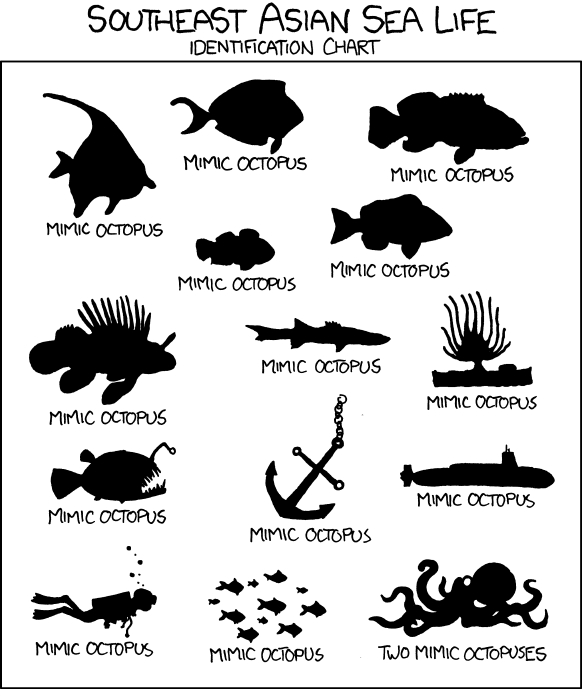 |
| From xkcd.com by Randall Munroe |
Saturday, January 22, 2011
Thailand Closes 18 Coral Reef Diving Sites
Dive sites in 7 national parks across Thailand have been closed in response to coral bleaching that has affected up to 80% of corals surveyed.
According to the Bangkok Post, the sites affected are:
According to the Bangkok Post, the sites affected are:
Hat Chao Mai National Park in Trang, Mu Koh Petra and Tarutao national parks in Satun, Mu Koh Chumphon National Park in Chumphon, Hat Nopparat Thara-Mu Koh Phi Phi National Park in Krabi, and Mu Koh Surin and Mu Koh Similan national parks in Phangnga.The bleaching is attributed to elevated sea temperatures in past years. Closing the sites off to tourists will certainly reduce damage from irresponsible divers and waders (see this photo (via NYT) for something horrifying), but it will not do anything about the coral bleaching itself.

Wednesday, January 19, 2011
'Avatar' Director Plans Deep Ocean Dive for Next Movie
Director James Cameron has commissioned a deep-diving submersible, being built in Australia, to dive to the deepest point in the world's oceans, the Mariana Trench of the Pacific, in order to film undersea footage for his upcoming sequel to 2009's blockbuster movie Avatar.
The article linked to above has a great summary of the last (and only) successful dive into Challenger Deep, the deepest part of the Trench, which was the Trieste dive of 1960. The Trieste was a custom-built submersible, comprising a spherical capsule in which the two crew sat with their instruments, suspended underneath a giant container of gasoline. It functioned like an underwater blimp: the gasoline acted as the buoyant balloon, and they carried ballast to bring them down, which was jettisoned for the ascent. It's a great story of engineering and derring-do, unfortunately not much was learned about the biology of the deep sea from that expedition.
I particularly liked the writer's description of how life can survive at such high pressures in the deep:
The article linked to above has a great summary of the last (and only) successful dive into Challenger Deep, the deepest part of the Trench, which was the Trieste dive of 1960. The Trieste was a custom-built submersible, comprising a spherical capsule in which the two crew sat with their instruments, suspended underneath a giant container of gasoline. It functioned like an underwater blimp: the gasoline acted as the buoyant balloon, and they carried ballast to bring them down, which was jettisoned for the ascent. It's a great story of engineering and derring-do, unfortunately not much was learned about the biology of the deep sea from that expedition.
I particularly liked the writer's description of how life can survive at such high pressures in the deep:
One oceanographer described how as follows: a human is like a party balloon – taken down to great depths it will be crushed to nothing; but a deep-sea fish is like an untied balloon – take that down to the bottom of the ocean and the pressure has little effect. Perhaps the greatest difficulty is that intense pressure causes nerves to stop working, a problem that deep-sea life has side-stepped by evolving a more robust physiology at molecular level.Cameron's quest is not really a scientific expedition, but is still an exciting opportunity for observation of life in the deep sea. The director is also known for his underwater documentary film-making, such as Volcanoes of the Deep Sea featuring the submersible Alvin). Given that the marine realm has inspired many of Cameron's cinematic works (Aliens, The Abyss, Avatar, and of course Titanic) it's only natural that he returns to it for inspiration, like marine enthusiasts all over the world, except with deeper pockets!
Monday, January 10, 2011
Dolphins for Sentosa Resort Moved to Philippines?
The proposed Marine Life Park run by Resorts World Sentosa (RWS) has come under fire for its planned dolphin show ever since word about it got out to the public. The dolphins were captured from the wild in the Solomon Islands and shipped first to the Philippines then to Langkawi, where they have been held for training.
Last October, two (out of seven) were reported to have died from a bacterial infection. In the last month, they have been moved again. According to Today Online:
In reply, a member of the public claims that having "dolphins and whales in captivity is not about education or conservation, it is about one thing - profit,"and that the best place to learn from them is in their natural habitat.
Now that nature documentaries have become so advanced both in technical terms and in narrative sophistication, I think that one would learn more from watching a good film about the life and behavior of dolphins, filmed in the wild with wild animals, than from paying to see a handful of caged animals performing tricks. I'm not saying that zoos don't have value; what I have in mind are rare animals whose beauty and fascination lie as much in their behavior and interactions with their natural environment as with their physical appearance. Dolphins certainly fall in this category.
Last October, two (out of seven) were reported to have died from a bacterial infection. In the last month, they have been moved again. According to Today Online:
An employee who wanted to be known as Ahmed, told MediaCorp that the dolphins were put into a container last month and sent to Langkawi's international airport, from where they shipped to the Philippines.RWS has defended its decision to have a dolphin display by saying that it complied with CITES regulations on the trafficking of endangered species, and that the display would be "educating the public on marine life and environmental issues."
In reply, a member of the public claims that having "dolphins and whales in captivity is not about education or conservation, it is about one thing - profit,"and that the best place to learn from them is in their natural habitat.
Now that nature documentaries have become so advanced both in technical terms and in narrative sophistication, I think that one would learn more from watching a good film about the life and behavior of dolphins, filmed in the wild with wild animals, than from paying to see a handful of caged animals performing tricks. I'm not saying that zoos don't have value; what I have in mind are rare animals whose beauty and fascination lie as much in their behavior and interactions with their natural environment as with their physical appearance. Dolphins certainly fall in this category.
Saturday, January 08, 2011
Ammonite Jaws Reconstructed in 3D with X-rays
Ammonites are common fossils with distinctive chambered spiral shells – so common that they're probably some of the first fossils most of us encounter, as decorative objects sitting prettily in someone's home or workplace. They're cephalopods, extinct relatives of the octopus, squid, and cuttlefish, but unlike these, have an external shell. The still-extant Nautilus is a cephalopod with an external shell, and is often confused with the ammonites, but these two actually represent two different lineages within the cephalopods.
Like most molluscs, ammonites had a (presumably) chitinous feeding apparatus comprising jaws and a radula–a rasping row of teeth-like structures unique to molluscs. These have been recovered occasionally in the past, but using X-rays, these have been studied in-situ in the ammonite Baculites from the Upper Cretaceous of South Dakota, allowing them to be reconstructed in breathtaking, 3-dimensional detail (paper in Science).
What's more, the food of these creatures can also be detected and identified. Within the buccal mass of these ammonites were fragments of small isopods, also called pill-bugs, which are crustaceans that, as their name suggests, look like rounded pills.
Unlike Nautilus and other nautiloids, the jaw structure and the kind of food they ate suggest that Baculites fed on small prey in the water column (i.e. zooplankton), instead of larger prey on the sea floor (benthic). They hypothesize that this preference for planktonic food may be responsible for the extinction of ammonites at the end of the Cretaceous, when the composition of planktonic communities changed considerably, but this theory will certainly have to be tested with more fossil data, as the commentary article points out.
Like most molluscs, ammonites had a (presumably) chitinous feeding apparatus comprising jaws and a radula–a rasping row of teeth-like structures unique to molluscs. These have been recovered occasionally in the past, but using X-rays, these have been studied in-situ in the ammonite Baculites from the Upper Cretaceous of South Dakota, allowing them to be reconstructed in breathtaking, 3-dimensional detail (paper in Science).
What's more, the food of these creatures can also be detected and identified. Within the buccal mass of these ammonites were fragments of small isopods, also called pill-bugs, which are crustaceans that, as their name suggests, look like rounded pills.
Unlike Nautilus and other nautiloids, the jaw structure and the kind of food they ate suggest that Baculites fed on small prey in the water column (i.e. zooplankton), instead of larger prey on the sea floor (benthic). They hypothesize that this preference for planktonic food may be responsible for the extinction of ammonites at the end of the Cretaceous, when the composition of planktonic communities changed considerably, but this theory will certainly have to be tested with more fossil data, as the commentary article points out.
Tuesday, October 12, 2010
Sherman's Lagoon and the Census of Marine Life
The Census of Marine Life (CoML) is an international project to account for the world's marine biodiversity. Launched in 2000, it has now completed a decade of research, and is celebrating this milestone with a conference in London.
The results have been more than just scientific publications and pretty coffee table books. Artwork inspired by the Census includes a storyline in Jim Toomey's comic strip Sherman's Lagoon (scroll down this page to see), which follows the foibles of a (not very bright) Great White shark and his friends. Toomey has given a TED talk where he talks about his love of the ocean and marine life, including his stand against shark finning.
The results have been more than just scientific publications and pretty coffee table books. Artwork inspired by the Census includes a storyline in Jim Toomey's comic strip Sherman's Lagoon (scroll down this page to see), which follows the foibles of a (not very bright) Great White shark and his friends. Toomey has given a TED talk where he talks about his love of the ocean and marine life, including his stand against shark finning.
Tuesday, August 24, 2010
Sea grape symbionts - parasites turned mutualists
The research project that I'm working on involves a symbiotic protist found in sea grapes, which are a family of sea squirts, or ascidians - sessile, filter feeding invertebrates which turn out to be close relatives of vertebrates (they're also chordates). Carl Zimmer, a science writer at the NY Times and other publications, has just blogged about a paper just published by one of my advisers, Mary Beth Saffo, and collaborators. The paper has been a long time in the works, so it's gratifying to see that it's gotten some publicity already. It's interesting how these things work, though - he found out about it because he was visiting the same marine biology station where she was doing some field work. There's plenty of serendipity in science communication, on top of the inherent general interest of the work itself.
Saturday, July 17, 2010
Pretty Pictures: Deep-Sea Creatures from Great Barrier Reef
Australian scientists have photographed deep sea creatures living at the iconic Great Barrier Reef using remote-controlled submersibles. More photographs here.
My question: Why is the Queensland Brain Institute involved in oceanography?
My question: Why is the Queensland Brain Institute involved in oceanography?
Monday, July 13, 2009
NY Times feature on whales and us
"Human-whale relations have long been defined by this stark dualism: manic swings between mythologizing and massacre; between sublime awe and assiduous annihilation, the testimonies of their slayers often permeated with a deep sense of both remorse and respect for the victims."
In between these extremes, the relationship between humans and whales turns out to be social and complex. Among themselves, whales have languages, communities, and actually resemble us more than we would care to admit. So given our history of hunting whales and driving them to suicide by the cacophony of underwater sonar, could they find it in their hearts to forgive us?
Towards its conclusion, this article by Charles Siebert raises the issue of anthropomorphism. Because of the close parallels in their behavior and sociality to that of our own species, it is tempting to suppose that whales and other cetaceans have feelings and motivations like we do, that they feel sadness or gladness when they display aversion or preference.
Anthropomorphism has long been the big taboo in the field of ethology, because of the concern that it is unscientific and sentimental, so generations of behaviorists have been taught to refer to their animal subjects by numbers rather than names, and to carefully suppress their instinct to ascribe human-like motivations and feelings to them. The scientist that the author quotes, Toni Frohoff, is quick to say: "I don't anthropomorphize", but also that "those who would reject out of hand the idea that whales are intelligent enough to consciously interact with us haven’t spent enough time around whales."
The intuition of a seasoned and experienced observer encodes subtle nuances and detail that the hypothesis-testing model of science can be blind to. The question, of course, is how to translate the ineffable quality of a humpback gently nudging a dive team that had recently freed it from a tangle of rope into some convincingly systematic scheme of explanation. It would be very satisfying if the rigorous study of cetaceans can give us insight into whether these animals, like us, are able to lead rich and interesting internal lives.
Sunday, April 13, 2008
Biophilia Programme - Finding Nemo
The morning started out with a nice view of the seashore exposed by the low tide (0.3m). The sky was clear and the sound of the ebbing waves beckoned.

The students were to carry out their transect study. I was with a group of them when they set up a 40 m long line transect across the intertidal zone. It must have been one of those fulfilling days as a bio teacher. The sun, the sand and the ebbing waves washing at our ankles as we looked for yet one more creature to surprise us with its existence in its strange form. The day's new creature of the day started off with the slender seamoth.
Its not uncommon on these fieldtrips to the shore to hear students go "wow" in amazement at an entirely new creature they have seen.... Come to think of it.. how many times in our lives do we come across anything really new in the flesh.

The slender seamoth was really calm as we comtemplated it... see the shadows of our heads hovering over it as we trained camera lenses on it. We pondered over whether it was a stargazer or seawasp.
That's the 40m transect which took a group an hour plus to complete documenting the creatures they saw.

And here's a makeshift square transect that the group who had done were particularly proud of.

The low tide really exposed a lot of creatures and lots of carpet anemones were exposed in those pools. It was with Mr Nah's patience and keen eye that we spotted the prawn that was swimming within those tentacles of one. And soon enough what must have been quite the highlight of the day was to spot a clownfish, at home within the tentacle of the carpet anemone. Now, we have seen Nemo in aquarium and the movies, but to come across on in situ was a different thing all together... we all beamed at such a discovery.

It must have been on of the most fulfilling visits to that fieldsite. I think partly it could be attributed to the fact that we set up transects and had a more considered approach to our survey.

We work to the ominous backdrop of mega construction and each time I go there, I half expect the place to be cleared and cordoned off for some pointless attraction. The day that happens, I will be cynical, for I have come to know of creatures who await discovery by students.
The students were to carry out their transect study. I was with a group of them when they set up a 40 m long line transect across the intertidal zone. It must have been one of those fulfilling days as a bio teacher. The sun, the sand and the ebbing waves washing at our ankles as we looked for yet one more creature to surprise us with its existence in its strange form. The day's new creature of the day started off with the slender seamoth.
Its not uncommon on these fieldtrips to the shore to hear students go "wow" in amazement at an entirely new creature they have seen.... Come to think of it.. how many times in our lives do we come across anything really new in the flesh.
The slender seamoth was really calm as we comtemplated it... see the shadows of our heads hovering over it as we trained camera lenses on it. We pondered over whether it was a stargazer or seawasp.
That's the 40m transect which took a group an hour plus to complete documenting the creatures they saw.
And here's a makeshift square transect that the group who had done were particularly proud of.
The low tide really exposed a lot of creatures and lots of carpet anemones were exposed in those pools. It was with Mr Nah's patience and keen eye that we spotted the prawn that was swimming within those tentacles of one. And soon enough what must have been quite the highlight of the day was to spot a clownfish, at home within the tentacle of the carpet anemone. Now, we have seen Nemo in aquarium and the movies, but to come across on in situ was a different thing all together... we all beamed at such a discovery.
It must have been on of the most fulfilling visits to that fieldsite. I think partly it could be attributed to the fact that we set up transects and had a more considered approach to our survey.
We work to the ominous backdrop of mega construction and each time I go there, I half expect the place to be cleared and cordoned off for some pointless attraction. The day that happens, I will be cynical, for I have come to know of creatures who await discovery by students.
Sunday, February 24, 2008
Secrets of cuttlefish camouflage
Secrets of the Camouflage Masters. Cuttlefish seem to be able to camouflage themselves against any sort of background - rocks and pebbles, corals, even checkerboards. Robert Hanlon of the Woods Hole Marine Biological Laboratory has classified the different cuttlefish camouflage patterns and shown that they fall into three broad categories - uniform colour, mottled colour, and disruptive patterns (like stripes and spots). According to the article: "What he learned from cephalopods may apply throughout the animal kingdom. The fact that cephalopods may need just three camouflage categories could mean that there are just a few basic ways to fool predators." That puts a new spin on the age old problem of animal camouflage and concealment. The question to ask might not be 'why are these animal so good at blending into the background' but rather 'why are we (or why are predators) so bad at spotting these particular kinds of patterns against the background?' A predator-centered approach might need to bring in theories of cognition and pattern-recognition.
One puzzling problem remains, though. Cuttlefish are colour blind yet they can adopt different colours in their camouflage. How do they manage to do so? No one yet knows....
One puzzling problem remains, though. Cuttlefish are colour blind yet they can adopt different colours in their camouflage. How do they manage to do so? No one yet knows....
Sunday, December 23, 2007
An Ode to Whales
There is something fascinating about whales and dolphins. I remember giving a lecture in school on Lipids (an 'A' level biology subtopic) and as a digression, I told the class a story about Whaling in Nantucket in the 18th century. Its somewhat related to lipids as the whaling industry was mainly based on the lipid found in the spermaceti of the sperm whale. A large whale could provide up to 3 tons of that valuable wax which was odorless and non-oily to the touch.
Anyway, I played some sound clips of whales singing (yes, they do sing and in different dialects too, depending on which pod they belong to) and after that auditory experience, the students (about 300) clapped and cheered. There must be something mesmerizing about whales in our human psyche. I was glad to know that most students displayed a sense of biophilia, sensu E.O. Wilson.
Scientifically, Cetaceans are animals belonging to the Order Cetacea, which, include whales, dolphins and porpoises.

Actually the reason why I am posting here is because I came across this article about whaling in Japan and its just inexplicable that whaling still occurs. Hey, I understand if the Iñupiat Eskimos do it to survive (see my post on a book I read about Eskimo whaling) but to state scientific reasons for whaling is entirely beyond reasonable acceptance. Its like killing cats randomly and saying we need data.

Note this statement - "Over a six-month period, it will kill 1,000 whales as part of what it says is a scientific research programme."
I am no whale fanatic but they are just lovely creatures. I have had nice dreams about dolphins and whales too and those were deep and meaningful ones for me. They at least represent the wonders that nature has produced. And at most, are inspiring to many people. Scientifically, the are really peculiar and interesting ends of the evolutionary tree. See link below about the recent fossil discovery that shed new light on the evolutionary research to trace which extinct land-dwelling mammals were the probable ancestors of Cetaceans

Ivan's Dolphins Galaxia and Into the Deep feature some whale and dolphin sounds. They are so enchanting and give a sensitive dimension to the music.
My point is "Stop Whaling!"
Anyway, I played some sound clips of whales singing (yes, they do sing and in different dialects too, depending on which pod they belong to) and after that auditory experience, the students (about 300) clapped and cheered. There must be something mesmerizing about whales in our human psyche. I was glad to know that most students displayed a sense of biophilia, sensu E.O. Wilson.
Scientifically, Cetaceans are animals belonging to the Order Cetacea, which, include whales, dolphins and porpoises.
Actually the reason why I am posting here is because I came across this article about whaling in Japan and its just inexplicable that whaling still occurs. Hey, I understand if the Iñupiat Eskimos do it to survive (see my post on a book I read about Eskimo whaling) but to state scientific reasons for whaling is entirely beyond reasonable acceptance. Its like killing cats randomly and saying we need data.
Note this statement - "Over a six-month period, it will kill 1,000 whales as part of what it says is a scientific research programme."
I am no whale fanatic but they are just lovely creatures. I have had nice dreams about dolphins and whales too and those were deep and meaningful ones for me. They at least represent the wonders that nature has produced. And at most, are inspiring to many people. Scientifically, the are really peculiar and interesting ends of the evolutionary tree. See link below about the recent fossil discovery that shed new light on the evolutionary research to trace which extinct land-dwelling mammals were the probable ancestors of Cetaceans
Ivan's Dolphins Galaxia and Into the Deep feature some whale and dolphin sounds. They are so enchanting and give a sensitive dimension to the music.
My point is "Stop Whaling!"
Subscribe to:
Posts (Atom)