As I announced over a year ago, I have a website featuring the protists (protozoans and algae) that one can find in freshwater (ponds, reservoirs, drains...) in Singapore. The pages are illustrated with pictures (photomicrographs) and videos, and are organized as a guidebook (inspired by the Singapore Science Centre nature guidebooks that I grew up with).
With my collection of videos, though, I wanted to put them together into a documentary-style film, and I finally found time to do it this summer.
Hidden Lives (SD) from brandon seah on Vimeo.
This was made with iMovie '08, with music sourced from ccMixter. Feel free to share, with credits! Read more about the motivation here.
Showing posts with label video. Show all posts
Showing posts with label video. Show all posts
Monday, June 03, 2013


Monday, April 09, 2012
Plankton Chronicles
The word "plankton" literally means "wanderer", and these floating wanderers of the ocean have a strange and alien beauty that has fascinated generations of biologists.
The Plankton Chronicles project uses modern microscopy and videography to make this world accessible to the average armchair explorer. They've produced a series of videos highlighting different planktonic organisms, using a technique called dark field optics, where objects are made visible by the light that they scatter, appearing light against a dark background.
The project is a collaboration between the Tara Oceans Expedition and the Oceanographical Observatory at Villefranche-sur-Mer.
One of the episodes, on planktonic protists (of course!), is embedded below:
I came by the site by way of this TED Talk by Tierney Thys:
The Plankton Chronicles project uses modern microscopy and videography to make this world accessible to the average armchair explorer. They've produced a series of videos highlighting different planktonic organisms, using a technique called dark field optics, where objects are made visible by the light that they scatter, appearing light against a dark background.
The project is a collaboration between the Tara Oceans Expedition and the Oceanographical Observatory at Villefranche-sur-Mer.
One of the episodes, on planktonic protists (of course!), is embedded below:
I came by the site by way of this TED Talk by Tierney Thys:
Wednesday, December 28, 2011
How the 'brinicle' was filmed
If you haven't seen this video by now, you should watch it!
As sea ice freezes in the Antarctic, it leaves behind a concentrated brine which is trapped in channels within the ice. When this cold, dense brine, which is colder than the freezing point of water, seeps to the underside of the ice layer and sinks into the water beneath, it forms a sheath of frozen water around it, which eventually extends to the sea floor as a 'brinicle'.
For the BBC Nature series Frozen Planet, these brinicles were filmed for the very first time. The film's producer, Kathryn Jeffs, said that when she was preparing to film them, she couldn't find any information about them, even on the Internet.
Now, this video is among the most popular nature video clips online.
Jeff describes the technically demanding and physically difficult process of filming under thick ice in 2ºC water. As she put it, they were tremendously satisfied when they
As sea ice freezes in the Antarctic, it leaves behind a concentrated brine which is trapped in channels within the ice. When this cold, dense brine, which is colder than the freezing point of water, seeps to the underside of the ice layer and sinks into the water beneath, it forms a sheath of frozen water around it, which eventually extends to the sea floor as a 'brinicle'.
For the BBC Nature series Frozen Planet, these brinicles were filmed for the very first time. The film's producer, Kathryn Jeffs, said that when she was preparing to film them, she couldn't find any information about them, even on the Internet.
Now, this video is among the most popular nature video clips online.
Jeff describes the technically demanding and physically difficult process of filming under thick ice in 2ºC water. As she put it, they were tremendously satisfied when they
... knew [they] had captured, for the first time ever, the creation of a rather sinister wonder of nature.
Wednesday, October 12, 2011
Björk and the Zombie Snails
No, it's not a tribute band. The quirky Icelandic musician Björk has a new album out, called Biophilia. Appropriately enough, the tracks are inspired by themes of nature and biology.
One of the songs in particular, "Virus", was written after Björk learned about "zombie snails" on YouTube. It has nothing to do with real viruses, though (Disclaimer: I haven't heard the album yet so I can't say if the music is any good). These snails are parasitized by a trematode worm called Leucochloridium paradoxum, which you can see in the photo below.
Look closely at the eyestalk on the right. Yup, that's filled with worm. But it's not just one worm. It's a structure called the brood-sac, which contains hundreds of cercariae – little larval worms ("trematode life cycle" on Wikipedia. The sac is banded and green and pulsates. This attracts the attention of birds, which think that it's actually their favorite food, maggots or caterpillars. They swoop in and peck off an eyestalk with all the worms in them. The worms end up in the gut of the bird, and are carried in there to be pooped out somewhere else. Free transportation! Snails grazing along eat some bird poop with the parasites in them, and get infected, completing the cycle.
Find out more about the sneaky life cycle of this worm from this article on Wired magazine, or read the Wikipedia article, or just watch the video that inspired Björk:
One of the songs in particular, "Virus", was written after Björk learned about "zombie snails" on YouTube. It has nothing to do with real viruses, though (Disclaimer: I haven't heard the album yet so I can't say if the music is any good). These snails are parasitized by a trematode worm called Leucochloridium paradoxum, which you can see in the photo below.
 |
| Snail infected with Leucochloridium paradoxum in its eyestalk. |
Find out more about the sneaky life cycle of this worm from this article on Wired magazine, or read the Wikipedia article, or just watch the video that inspired Björk:
Wednesday, September 28, 2011
Great TED Talks for biologists!
Tim Handorf from the website Bestcollegesonline.com has compiled a list of "20 Unbelievable TED Talks for Biology Majors". These are very much worth watching! Among the highlights: Bonnie Bassler on how bacteria "talk" to each other, and John Kasaona on how poachers can become caretakers of wildlife.
The TED Talks are the cornerstone of the TED organization, a non-profit whose name stands for "Technology, Entertainment, and Design". They bring together people who have, as they put it, "Ideas Worth Spreading" and put their talks online. These ideas range from social causes to science and technology.
They're definitely good to watch and attention-grabbing, as you might expect from hearing people who're talking about what they are most passionate about.
One of my favourite videos which isn't on the list is David Gallo's show-and-tell of "Underwater Astonishments", ranging from deep-sea bioluminescent patterns (Edith Widder, who took the these videos, has a talk of her own) to the clever and changeable world of cephalopods (squid and octopods):
Linkl
The TED Talks are the cornerstone of the TED organization, a non-profit whose name stands for "Technology, Entertainment, and Design". They bring together people who have, as they put it, "Ideas Worth Spreading" and put their talks online. These ideas range from social causes to science and technology.
They're definitely good to watch and attention-grabbing, as you might expect from hearing people who're talking about what they are most passionate about.
One of my favourite videos which isn't on the list is David Gallo's show-and-tell of "Underwater Astonishments", ranging from deep-sea bioluminescent patterns (Edith Widder, who took the these videos, has a talk of her own) to the clever and changeable world of cephalopods (squid and octopods):
Linkl
The TED concept has also spread to different countries and cities with the TEDx series, which are TED events organized by independent organizations. In Singapore there's TEDxSingapore, TEDxNTU, and TEDxNUS. The Biology Refugia's own Sivasothi gave a talk about protecting biodiversity in Singapore for TEDxNUS:
In another video, graduate student Ang Yuchen explains his research on insect sexual selection:
Plenty more videos on all manner of subjects are available on the TED website. So instead of listening to yet another music video or watching cute kittens play with string on YouTube, why not check some of them out instead? You'll definitely learn something new!
Sunday, September 04, 2011
Swifts in the city
I live on the 18th floor and have a great view of the Eastern half of Singapore. It's also a great opportunity for bird-watching. What I can see from my window are not pigeons and crows, but those fascinating birds the swifts. Here's a video of one twirling in circles at the same height as my building.
Swifts circling outside my window from brandon seah on Vimeo.
The main problems with swift-watching are apparent from the video: they fly very fast and they're up very high. Living on the top floor solves the second problem but not the first, though sometimes I can get a fleeting close-up glimpse when they return to perch or nest in the roof above me.
When trying to look up more information about them, I found an entry on Ria Tan's website on Sungei Buloh flora and fauna. Swifts belong to a family of birds called the Apodidae, and the common swifts are in the genus Apus, which means "no feet". Swifts actually do have feet, but they're small and used mostly for perching rather than walking.
Here's some interesting facts I learned:
Swifts can be confused with swallows, because both have the crescent-shaped wing profile characteristic of fast fliers. The two groups of birds are actually not very closely related. Swifts generally forage at higher altitudes than swallows, fly with a rapid flicking motion, and have shorter tails that are not notched at the ends.
Lately the LTA has been doing some works close to my home for the upcoming Downtown Line of the MRT. Part of Bedok Town Park close to the road has been flattened: the trees cut down and the ground dug into. Quite a number of swifts (among other birds) were circling over that area, fairly close to the ground, and I think they might have been hunting down the insects and other critters churned up by the works.
Swifts circling outside my window from brandon seah on Vimeo.
The main problems with swift-watching are apparent from the video: they fly very fast and they're up very high. Living on the top floor solves the second problem but not the first, though sometimes I can get a fleeting close-up glimpse when they return to perch or nest in the roof above me.
When trying to look up more information about them, I found an entry on Ria Tan's website on Sungei Buloh flora and fauna. Swifts belong to a family of birds called the Apodidae, and the common swifts are in the genus Apus, which means "no feet". Swifts actually do have feet, but they're small and used mostly for perching rather than walking.
Here's some interesting facts I learned:
- They live most of their life "on the wing" - eating, drinking, mating, and even sleeping
- Their name is apt: they're among the fastest fliers in the world, achieving up to 110 km/h
- Flying insects make up most of their diet
- Swifts are common, although the edible-nest swifts are threatened by indiscriminate nest-harvesting
- They're well-adapted to live in anthropogenic environments
Swifts can be confused with swallows, because both have the crescent-shaped wing profile characteristic of fast fliers. The two groups of birds are actually not very closely related. Swifts generally forage at higher altitudes than swallows, fly with a rapid flicking motion, and have shorter tails that are not notched at the ends.
Lately the LTA has been doing some works close to my home for the upcoming Downtown Line of the MRT. Part of Bedok Town Park close to the road has been flattened: the trees cut down and the ground dug into. Quite a number of swifts (among other birds) were circling over that area, fairly close to the ground, and I think they might have been hunting down the insects and other critters churned up by the works.
Tuesday, July 26, 2011
Singapore Protozoans Part 2 - A Murky Pond
After looking at today's sample (from a small pond in the botany garden at NUS) under the microscope I think I might hesitate to stick my hands into warm murky pond water again. It's absolutely crawling with bacteria, and to illustrate what I mean by crawling I've even got a video:
On the bright side, that means there's plenty of protists grazing on all these bacteria, including lots of small bacterivorous ciliates, and gliding euglenids (photo below). I really think that they look like twisted potato chips, don't you too? Diatom and dinoflagellates were common, but I saw more empty tests and frustules than living cells.
One of the highlights was a big amoeba which had really awesome cytoplasmic streaming and which moved by blebbing outwards in a way which is easier to show than to describe in words.
See the full set of photographs on Flickr. [Update 6/9/11 - I've moved all the photos to my new protist website and the Flickr album is no longer available.]
Bacteria moving from brandon seah on Vimeo.
On the bright side, that means there's plenty of protists grazing on all these bacteria, including lots of small bacterivorous ciliates, and gliding euglenids (photo below). I really think that they look like twisted potato chips, don't you too? Diatom and dinoflagellates were common, but I saw more empty tests and frustules than living cells.
  |
| "Potato chip" euglenids with flagellum that points in the direction of motion. |
One of the highlights was a big amoeba which had really awesome cytoplasmic streaming and which moved by blebbing outwards in a way which is easier to show than to describe in words.
Large Amoeba from brandon seah on Vimeo.
See the full set of photographs on Flickr. [Update 6/9/11 - I've moved all the photos to my new protist website and the Flickr album is no longer available.]
Singapore Protozoans Part 1
 |
| Heliozoan from Kranji Reservoir. Each unit on the graticule scale is 2.5 microns. |
Microscope, murky water, a camera, and free time.
Lately I've been volunteering at Darren Yeo's new freshwater biology lab, but Maxine, the graduate student whose project I'm supposed to help with, has been busy with the Honours fieldtrip to Pulau Tioman and with getting sick (get well soon!) In the meantime, I've found that her plankton net samples from Kranji Reservoir are teeming with interesting and picturesque protozoa!
Today I captured some shots of microscopic aquatic life to share online, and you can browse the full set on Flickr [update 6/9/11 - I've moved all the media to my new protist website and the album is no longer available]. The picture above shows an organism called a heliozoan. The long radiating arms, called axopods, appear to be beaded with dew drops, which are actually organelles involved in prey capture called extrusomes. The spherical cell body itself is covered in a layer of spicules, which seem like a fuzzy layer of hair, but reveal finely ornamented detail under electron microscopy.
These pictures were taken in a fairly primitive way: by balancing a camera in front of the eyepiece of the microscope. The microscope was set up for brightfield illumination, but I closed down the condenser aperture to improve contrast, in the absence of any better option. Still, there's enough detail to recognize lots of protozoans and to tell a good story.
When I've got a decent bunch of these pictures and descriptions, I'd like to eventually put up a photographic guide to common protozoans in Singapore. That might help to address some of the 'macrobe' bias in the natural history scene here, by showing the beauty hidden in the very small.
As a bonus here's a video of ciliates squirming in the carcass of a dead planktonic crustacean. The bright droplets are oil globules, which the ciliates are feeding on (ingested oil globules are also visible within their cytoplasm). Outside the animal carcass you can see another ciliate which has been left out of the feeding frenzy, and is trying to find its way in....
Monday, July 25, 2011
"Southeast Asian Sea Life" according to xkcd
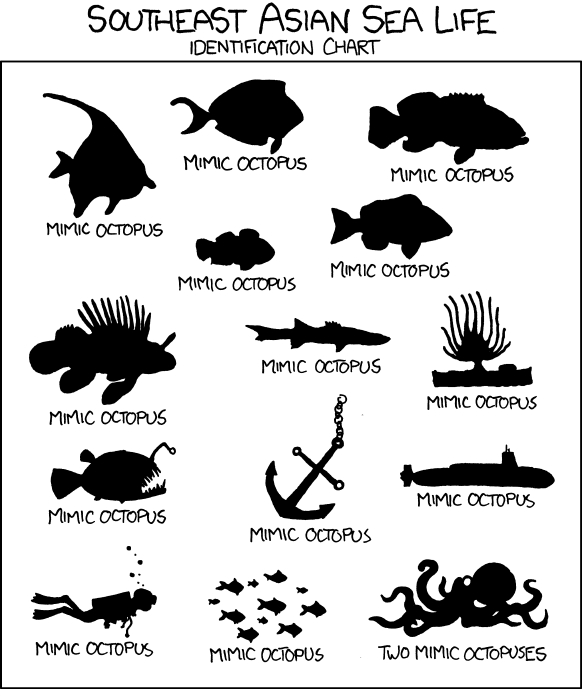 |
| From xkcd.com by Randall Munroe |
Wednesday, July 06, 2011
Who's a climate scientist?
Climate science researchers appear in a video produced and aired by the Australian satirical TV show Hungry Beast, titled "I'm a Climate Scientist." Among their reasons for doing so was to "[highlight] the issue of unqualified opinions on climate science by politicians, economists etc. in the media." (Source)
A sample of the lyrics:
A sample of the lyrics:
Who's a climate scientist?The video is embedded below, but warning: loud music and strong language. Via an article on scientist-turned-activist James Hansen in the Guardian.
I'm a climate scientist!
A penny-farthing cyclist?
Not a climate scientist!
A Fox News journalist? -- No!
A paleontologist? -- No!
A clean coal lobbyist? -- No!
A cashed-up alarmist? -- No!
Friday, May 20, 2011
Imitation, flattery, and body-plans
If imitation is the highest form of flattery, then ants might be among the most celebrated creatures of the insect world. A delightful essay in Current Biology describes some of the more uncanny cases of ant-mimicry among arthropods, among them the treehopper Cyphonia clavata.
The 'ant' that's apparently riding on the back of the treehopper is actually an extension of its headshield. The green coloration of the rest of its body blends in with its leafy background, so on first glance you only see the black 'ant'. The mimic is seated in reverse: if you look carefully at the 'abdomen' of the 'ant', you'll see the green eye of the treehopper staring right back at you. This makes sense because in their defensive posture, ants move backwards.
Creatures that mimic ants are called myrmecomorphs ('ant-shaped', from Greek). There are certainly a lot of ants out there to be imitated (Antweb has high-resolution scans of ant specimens from around the world). One statement in this essay got me thinking:
Treehoppers are true bugs (Hemiptera) in the family Membracidae. They are known for their headshields, also called helmets, which are responsible for the great diversity of form in this family. Some of them look like they may have inspired the fascinators worn by some of the women at the recent Royal wedding.
Developmental biologists have now found that the helmet is actually a body plan innovation (original paper abstract), something that's incredibly rare in evolution. New structures are typically formed by modifying or reducing existing parts of anatomy, but innovations such as new appendages or new body segments are much rarer.
Insects typically have a pair of legs on each of the three thoracic segments (T1 to T3), and wings on the 2nd and 3rd (T2 and T3). The helmet arises from the 1st thoracic segment (T1), and anatomical observations have suggested in the past that they might be homologues of wings. By looking at gene expression in a developing treehopper, biologists found that wing-specific transcription factors (which control the expression of other genes), especially Nubbin, are expressed in the developing helmet, which indicates that it's developmentally homologous to wing appendages. They suggest that the Hox genes responsible for suppressing wing formation in T1 have been suppressed in treehoppers, allowing the evolution of the helmet. Because they aren't needed for flight, they aren't faced with the same physical constraints and so have been able to develop into a wild variety of shapes and sizes.
So coming back to the statement about body plan resemblances quoted above, perhaps the idea is more beguiling than it actually should be. An ant mimic for sure will have to be bilaterally symmetrical, of the right ant size, but beyond that I don't think the prerequisites for mimicry can be quantified. For conceptual proof of this, watch this famous octopus species mimic in turn a brittlestar, lionfish, and sea snake.
 |
| Ant-mimicking treehopper Cyphonia clavata. Via Flickr. |
The 'ant' that's apparently riding on the back of the treehopper is actually an extension of its headshield. The green coloration of the rest of its body blends in with its leafy background, so on first glance you only see the black 'ant'. The mimic is seated in reverse: if you look carefully at the 'abdomen' of the 'ant', you'll see the green eye of the treehopper staring right back at you. This makes sense because in their defensive posture, ants move backwards.
Creatures that mimic ants are called myrmecomorphs ('ant-shaped', from Greek). There are certainly a lot of ants out there to be imitated (Antweb has high-resolution scans of ant specimens from around the world). One statement in this essay got me thinking:
"... there are about 2,000 species that mimic ants. Not surprisingly, these are nearly all insects or spiders, as a certain degree of body plan resemblance to ants is probably a prerequisite to becoming a myrmecomorph. ... ant mimicry must have evolved many times independently."
Treehoppers are true bugs (Hemiptera) in the family Membracidae. They are known for their headshields, also called helmets, which are responsible for the great diversity of form in this family. Some of them look like they may have inspired the fascinators worn by some of the women at the recent Royal wedding.
 |
| Diversity of treehopper headshield forms - Cyphonia clavata is at bottom right. Via Nature |
Insects typically have a pair of legs on each of the three thoracic segments (T1 to T3), and wings on the 2nd and 3rd (T2 and T3). The helmet arises from the 1st thoracic segment (T1), and anatomical observations have suggested in the past that they might be homologues of wings. By looking at gene expression in a developing treehopper, biologists found that wing-specific transcription factors (which control the expression of other genes), especially Nubbin, are expressed in the developing helmet, which indicates that it's developmentally homologous to wing appendages. They suggest that the Hox genes responsible for suppressing wing formation in T1 have been suppressed in treehoppers, allowing the evolution of the helmet. Because they aren't needed for flight, they aren't faced with the same physical constraints and so have been able to develop into a wild variety of shapes and sizes.
So coming back to the statement about body plan resemblances quoted above, perhaps the idea is more beguiling than it actually should be. An ant mimic for sure will have to be bilaterally symmetrical, of the right ant size, but beyond that I don't think the prerequisites for mimicry can be quantified. For conceptual proof of this, watch this famous octopus species mimic in turn a brittlestar, lionfish, and sea snake.
Monday, January 24, 2011
Latest named cat species actually two subspecies
The Sunda clouded leopard (Neofelis diardi) was recognized as a distinct species, separate from the mainland Southeast Asian clouded leopard N. nebulosa, in 2008. Both are Vulnerable species, according to the IUCN.
Based on molecular genetic data, researchers suspected that the Sunda clouded leopard might actually represent two different subspecies, and this has been confirmed by a combination of molecular genetics and skull/dental features. There may be additional differences in coat patterning, but the number of specimens available for inspection is not enough to make a definitive statement.
The two subspecies are geographically separated: the Sumatran subspecies (N. diardi diardi) and the Borneo subspecies (N. diardi borneensis). They were probably isolated from each other after Sundaland land bridges were cut off when sea levels rose after the last ice age.
The BBC has a good summary article including a rare video of the animal from Dermakot National Park in Sabah, Borneo.
Based on molecular genetic data, researchers suspected that the Sunda clouded leopard might actually represent two different subspecies, and this has been confirmed by a combination of molecular genetics and skull/dental features. There may be additional differences in coat patterning, but the number of specimens available for inspection is not enough to make a definitive statement.
The two subspecies are geographically separated: the Sumatran subspecies (N. diardi diardi) and the Borneo subspecies (N. diardi borneensis). They were probably isolated from each other after Sundaland land bridges were cut off when sea levels rose after the last ice age.
The BBC has a good summary article including a rare video of the animal from Dermakot National Park in Sabah, Borneo.
Wednesday, January 12, 2011
Glimpse of the Past - 'The Borneo Story' Online
The Borneo Story: 'Birds Nest Soup' from The Doozer on Vimeo.
Catching up on leisure reading over New Year, I re-encountered the name of Tom Harrisson, who has been described as a "polymath" - pioneering British anthropologist, WWII hero, long-time director of the Sarawak Museum, conservationist, but also a prickly personality whose character invited controversy and divided opinions.
I was pleased to find that a series of documentaries that he co-produced in the 1950s, titled 'The Borneo Story', is available online. One of them, "Birds Nest Soup", which won a prize at the Cannes Film Festival, is embedded above.
These documentaries are a valuable glimpse into the state of Borneo in the postwar period, when it was still a tropical idyll, relatively untouched by large-scale plantation agriculture. Now, of course, birds nest soup is often commercially produced by inducing swifts to nest in abandoned buildings or purpose-built 'hangars', instead of being collected from the wild.
A 2006 BBC documentary, "The Barefoot Anthropologist" (YouTube), hosted by David Attenborough, gives a sense of the man and his exploits, including how he "restarted headhunting in Borneo". It's not all happy memories, though: one of the Australian soldiers under his command during the war describes how he wanted to shoot Harrisson, and is visibly agitated talking about him, half a century on!
More about his life can be read in the biography by Judith Heimann, The Most Offending Soul Alive.
Saturday, January 01, 2011
Formosan Black Bears
Hwang Mei-hsiu (黃美秀), assistant professor at National Pingtung University of Science and Technology, Taiwan relates the challenges to study the ecology of Formosan Black Bears in a dialogue with President Ma Ying-jeou.
Prof Hwang describes the difficulties of studying the black bears in the remote mountains of Taiwan and rarities of sighting the illusive animals. She responded regretfully that she has no exact population figure despite 15 years of research. With initial estimates of about several hundred for the island, she added that the viable population figure should be 2,000. This reflects the endangered status of the bear in Taiwan
Watch the enchanting "making of" clip with Willy the Bear-tracking Dog. This canine is trained to search for bear droppings!
Note: clips in Chinese.
Prof Hwang describes the difficulties of studying the black bears in the remote mountains of Taiwan and rarities of sighting the illusive animals. She responded regretfully that she has no exact population figure despite 15 years of research. With initial estimates of about several hundred for the island, she added that the viable population figure should be 2,000. This reflects the endangered status of the bear in Taiwan
Watch the enchanting "making of" clip with Willy the Bear-tracking Dog. This canine is trained to search for bear droppings!
Note: clips in Chinese.
Saturday, December 18, 2010
Highlights from BBC's Decade of Discovery
A new program, "Decade of Discovery", by the BBC showcases the 'greatest hits' from the past 10 years of natural history exploration, including the first live images of the barreleye fish (which can only look up and has a transparent dome over its head), the world's longest stick-insect, and more. Some video clips are available on the BBC's YouTube channel or from the TV program's webpage linked above, and the Guardian newspaper has a picture gallery of highlights if you're in a hurry.
Friday, July 30, 2010
Picture this - Drosophila germ band formation
Explaining Drosophila development just after the cellularisation process to a student can be tough. I tried to and ended up searching youtube for animations. It's mentally difficult to picture the invagination of the mesoderm and then the migration of blastoderm cells to initiate germ band formation from worded descriptions. I am quoting this segment from the wikipedia on germ band extension "During this process the ventral germ-band extends around the posterior end of the embryo, effectively folding over onto the dorsal side of the egg. Multiple individual cells intercalating mediolateral to the anterior-posterior axis drive the resulting global elongation of the embryo." How does one get a handle on that?
Developmental Biology was one of my favorite subjects in NUS, taught by the enthusiastic and nurturing Prof Lim Tit Meng (now director of the Singapore Science Centre). Those days we had plasticine models to play with to help us figure out gastrulation. If you didn't have good spatial cognitive skills, good luck to you. So I am highlighting this video from the Garland Science channel that immediately solves the problem. Two thumbs up. It gets five popcorns from me.
Developmental Biology was one of my favorite subjects in NUS, taught by the enthusiastic and nurturing Prof Lim Tit Meng (now director of the Singapore Science Centre). Those days we had plasticine models to play with to help us figure out gastrulation. If you didn't have good spatial cognitive skills, good luck to you. So I am highlighting this video from the Garland Science channel that immediately solves the problem. Two thumbs up. It gets five popcorns from me.
Wednesday, May 19, 2010
Evolve Music!
What happens when you cross modern European musical tastes with biological geekiness? A project like Darwin Rocks! This online game was produced by the Animal Evolutionary Ecology group at Eberhard Karls Universität Tübingen. It generates a few short pieces of synthetic music that has a number of variable traits: type of beat, instruments, key, rhythm. The user selects which ones he or she likes and dislikes, and then 'evolves' them for a number of generations. Repeat this process, and eventually, or so the idea is, you get a piece of music that has evolved to fit your musical preferences!
A neat way to spend a lazy afternoon, but one drawback is that most casual browsers will not attentively listen to all of the clips in their entirety. The 'hidden variation' that you don't observe can actually make the results quite different from what you were expecting! At least when I tried it out, it was producing some pretty awful sounds....
But it's worth visiting to have a look at the promotional music video they've made to illustrate the principle of Darwinian fitness. Or as the press release says: "The song and the music video with the title “Struggle for love” are about love, fight, and the right mix in evolution."
Sunday, May 09, 2010
Great clean energy ad
That's all I can say without giving too much of a spoiler to this video.
(Thanks to Keru for sending this along.)
(Thanks to Keru for sending this along.)
Thursday, September 24, 2009
HOME - Yann Arthus-Bertrand

Wednesday, August 13, 2008
David Attenborough's 1973 Royal Institution Christmas Lectures
"The Royal Institution Christmas Lectures have been held in London annually since 1825." [see Wikipedia] Michael Faraday (who is quite the man) is the star of the series which continues to this day. He lectured a record of 19 times between 1827 - 1860! The scene of one of his lectures is depicted on a UK 20-pound note and is a depiction I remember from my childhood.
In 1973, Sir David Attenborough, who has inspired many a naturalists' career in Singapore and elsewhere, participated in this grand event by giving a series of five lectures over five days, on "The Language of Animals":
The videos are available at the Royal Institution of Great Britain's webcast archive (you have to “shop” and “checkout” but can watch the webcast for free).
This excellent series of videos (and a dashing David) are available on YouTube courtesy of threespeed. Due to YouTube's 10 minute limitation, the series of five hour-long lectures are in 30 parts!
Besides highlighting these clips to the biodiversity and animal behaviour students, they serve as appropriate inspiration just before my module-heavy semester begins. I'll soak in ol'David to stoke those flames of passion and hope some fire is evident during the 8am ecology lecture!
In 1973, Sir David Attenborough, who has inspired many a naturalists' career in Singapore and elsewhere, participated in this grand event by giving a series of five lectures over five days, on "The Language of Animals":
- "Beware" (Wed 26 Dec 1973)
- "Be mine" (Thu 27 Dec 1973)
- "Parents and children" (Fri 28 Dec 1973)
- "Foreign languages" (Sat 29 Dec 1973)
- "Animal language, human language" (Sun 30 Dec 1973).
The videos are available at the Royal Institution of Great Britain's webcast archive (you have to “shop” and “checkout” but can watch the webcast for free).
This excellent series of videos (and a dashing David) are available on YouTube courtesy of threespeed. Due to YouTube's 10 minute limitation, the series of five hour-long lectures are in 30 parts!
Besides highlighting these clips to the biodiversity and animal behaviour students, they serve as appropriate inspiration just before my module-heavy semester begins. I'll soak in ol'David to stoke those flames of passion and hope some fire is evident during the 8am ecology lecture!
Subscribe to:
Posts (Atom)