 |
| From xkcd.com by Randall Munroe |
Showing posts with label mimicry. Show all posts
Showing posts with label mimicry. Show all posts
Monday, July 25, 2011
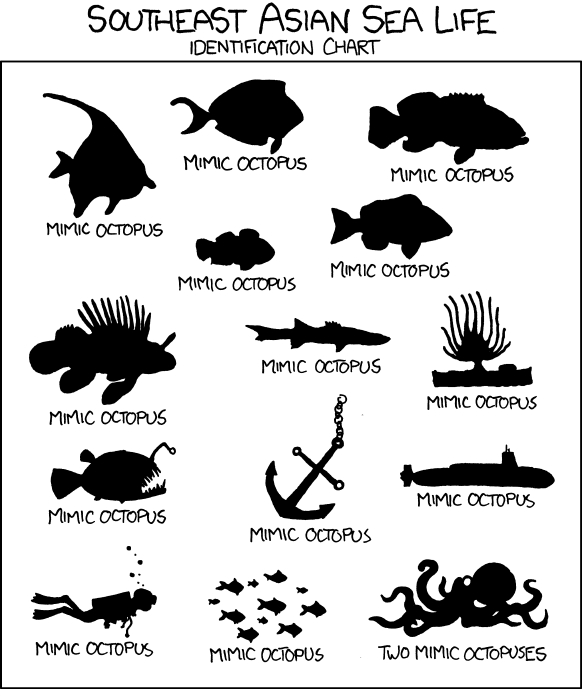
"Southeast Asian Sea Life" according to xkcd


Friday, May 20, 2011
Imitation, flattery, and body-plans
If imitation is the highest form of flattery, then ants might be among the most celebrated creatures of the insect world. A delightful essay in Current Biology describes some of the more uncanny cases of ant-mimicry among arthropods, among them the treehopper Cyphonia clavata.
The 'ant' that's apparently riding on the back of the treehopper is actually an extension of its headshield. The green coloration of the rest of its body blends in with its leafy background, so on first glance you only see the black 'ant'. The mimic is seated in reverse: if you look carefully at the 'abdomen' of the 'ant', you'll see the green eye of the treehopper staring right back at you. This makes sense because in their defensive posture, ants move backwards.
Creatures that mimic ants are called myrmecomorphs ('ant-shaped', from Greek). There are certainly a lot of ants out there to be imitated (Antweb has high-resolution scans of ant specimens from around the world). One statement in this essay got me thinking:
Treehoppers are true bugs (Hemiptera) in the family Membracidae. They are known for their headshields, also called helmets, which are responsible for the great diversity of form in this family. Some of them look like they may have inspired the fascinators worn by some of the women at the recent Royal wedding.
Developmental biologists have now found that the helmet is actually a body plan innovation (original paper abstract), something that's incredibly rare in evolution. New structures are typically formed by modifying or reducing existing parts of anatomy, but innovations such as new appendages or new body segments are much rarer.
Insects typically have a pair of legs on each of the three thoracic segments (T1 to T3), and wings on the 2nd and 3rd (T2 and T3). The helmet arises from the 1st thoracic segment (T1), and anatomical observations have suggested in the past that they might be homologues of wings. By looking at gene expression in a developing treehopper, biologists found that wing-specific transcription factors (which control the expression of other genes), especially Nubbin, are expressed in the developing helmet, which indicates that it's developmentally homologous to wing appendages. They suggest that the Hox genes responsible for suppressing wing formation in T1 have been suppressed in treehoppers, allowing the evolution of the helmet. Because they aren't needed for flight, they aren't faced with the same physical constraints and so have been able to develop into a wild variety of shapes and sizes.
So coming back to the statement about body plan resemblances quoted above, perhaps the idea is more beguiling than it actually should be. An ant mimic for sure will have to be bilaterally symmetrical, of the right ant size, but beyond that I don't think the prerequisites for mimicry can be quantified. For conceptual proof of this, watch this famous octopus species mimic in turn a brittlestar, lionfish, and sea snake.
 |
| Ant-mimicking treehopper Cyphonia clavata. Via Flickr. |
The 'ant' that's apparently riding on the back of the treehopper is actually an extension of its headshield. The green coloration of the rest of its body blends in with its leafy background, so on first glance you only see the black 'ant'. The mimic is seated in reverse: if you look carefully at the 'abdomen' of the 'ant', you'll see the green eye of the treehopper staring right back at you. This makes sense because in their defensive posture, ants move backwards.
Creatures that mimic ants are called myrmecomorphs ('ant-shaped', from Greek). There are certainly a lot of ants out there to be imitated (Antweb has high-resolution scans of ant specimens from around the world). One statement in this essay got me thinking:
"... there are about 2,000 species that mimic ants. Not surprisingly, these are nearly all insects or spiders, as a certain degree of body plan resemblance to ants is probably a prerequisite to becoming a myrmecomorph. ... ant mimicry must have evolved many times independently."
Treehoppers are true bugs (Hemiptera) in the family Membracidae. They are known for their headshields, also called helmets, which are responsible for the great diversity of form in this family. Some of them look like they may have inspired the fascinators worn by some of the women at the recent Royal wedding.
 |
| Diversity of treehopper headshield forms - Cyphonia clavata is at bottom right. Via Nature |
Insects typically have a pair of legs on each of the three thoracic segments (T1 to T3), and wings on the 2nd and 3rd (T2 and T3). The helmet arises from the 1st thoracic segment (T1), and anatomical observations have suggested in the past that they might be homologues of wings. By looking at gene expression in a developing treehopper, biologists found that wing-specific transcription factors (which control the expression of other genes), especially Nubbin, are expressed in the developing helmet, which indicates that it's developmentally homologous to wing appendages. They suggest that the Hox genes responsible for suppressing wing formation in T1 have been suppressed in treehoppers, allowing the evolution of the helmet. Because they aren't needed for flight, they aren't faced with the same physical constraints and so have been able to develop into a wild variety of shapes and sizes.
So coming back to the statement about body plan resemblances quoted above, perhaps the idea is more beguiling than it actually should be. An ant mimic for sure will have to be bilaterally symmetrical, of the right ant size, but beyond that I don't think the prerequisites for mimicry can be quantified. For conceptual proof of this, watch this famous octopus species mimic in turn a brittlestar, lionfish, and sea snake.
Monday, April 18, 2011
Cuckoos mimic hawks to scare hosts
Cuckoos have a bad reputation, and it's probably going to get worse. They're known for being brood parasites, depositing their eggs in the nests of other bird species. When these hatch, the cuckoo chicks aggressively demand food from the host parents and also eject their unfortunate step-siblings from the nest. As a result, the cuckoo gets a free pass on child-raising.
It is little surprise that cuckoos coming in to lay their parasitic eggs are often 'mobbed' by the birds that they target, in order to drive them away. However, a recent study has found that 'naive' birds are reluctant to approach cuckoos that have a barred (striped) pattern on their undersides, compared to cuckoos that lack such a pattern. This is interpreted as a form of Batesian mimicry by the cuckoos, taking on the stripes of sparrowhawks, which are birds of prey.
Cuckoos therefore may use two different kinds of mimicry in their lives: as adults mimicking birds of prey to prevent host birds from attacking them, and in the nest mimicking host chicks to convince the host parents to feed them.
Sources:
It is little surprise that cuckoos coming in to lay their parasitic eggs are often 'mobbed' by the birds that they target, in order to drive them away. However, a recent study has found that 'naive' birds are reluctant to approach cuckoos that have a barred (striped) pattern on their undersides, compared to cuckoos that lack such a pattern. This is interpreted as a form of Batesian mimicry by the cuckoos, taking on the stripes of sparrowhawks, which are birds of prey.
Cuckoos therefore may use two different kinds of mimicry in their lives: as adults mimicking birds of prey to prevent host birds from attacking them, and in the nest mimicking host chicks to convince the host parents to feed them.
Sources:
- "Cuckoos mimic hawks to scare their hosts, says research," by Victoria Gill. BBC Earth News, 17 April 2011
- Welbergen, J. A. & N. B. Davies, 2011. A parasite in wolf's clothing: hawk mimicry reduces mobbing of cuckoos by hosts. Behavioral Ecology. First published online 21 Mar 2011, doi: 10.1093/beheco/arr008 [abstract].
Thursday, September 09, 2010
Fossilized leaf-mimic lacewings
Lacewings, or Neuroptera, are a order of insects with very distinctively patterned wings, as their names (both in English and Latin) suggest. Among insects in general, many species, especially the well-known leaf katydids, are mimics of flowering-plant leaves. Such leaf mimicry presumably is a form of camouflage that functions in either defence or in aid of predation.
Paleontologists working in China have discovered a rare set of lacewing fossils (open access article) from Middle Jurassic rocks at a site in Inner Mongolia which are leaf mimics - a useful adaptation given their large size. However, their age means that they pre-date the Cretaceous radiation of flowering plants. The relationship between flowering plants (angiosperms) and insects has been characterized as a synergistic adaptive radiation - both groups flourished in diversity on similar timescales, an observation explained by pointing to the frequent close relationships and associations between insects and angiosperms. Therefore, leaf mimicry has long been thought to be a post-angiosperm phenomenon, and virtually all known leaf-mimics pretend to be angiosperm leaves. These lacewings, however, appear to mimic cycads or bennettiales, both of which are non-flowering seed plants (gymnosperms) that dominated the pre-angiosperm plant world. Both fossil and extant cycads have distinctive pinnate leaves, which the lacewings resemble. These are very different in form from the typical angiosperm leaf.
On the whole this is a very neat story - close insect-plant associations or coevolution appeared long before the rise of the angiosperms. The change in plant communities from gymnosperm-dominated to angiosperm-dominated, however, would have diminished the effectiveness of these cycad mimics, and might explain their disappearance. Perhaps some later fossil discoveries, likely coming from China, the new hot-bed for paleontology, might shed more light on the affair....
Paleontologists working in China have discovered a rare set of lacewing fossils (open access article) from Middle Jurassic rocks at a site in Inner Mongolia which are leaf mimics - a useful adaptation given their large size. However, their age means that they pre-date the Cretaceous radiation of flowering plants. The relationship between flowering plants (angiosperms) and insects has been characterized as a synergistic adaptive radiation - both groups flourished in diversity on similar timescales, an observation explained by pointing to the frequent close relationships and associations between insects and angiosperms. Therefore, leaf mimicry has long been thought to be a post-angiosperm phenomenon, and virtually all known leaf-mimics pretend to be angiosperm leaves. These lacewings, however, appear to mimic cycads or bennettiales, both of which are non-flowering seed plants (gymnosperms) that dominated the pre-angiosperm plant world. Both fossil and extant cycads have distinctive pinnate leaves, which the lacewings resemble. These are very different in form from the typical angiosperm leaf.
On the whole this is a very neat story - close insect-plant associations or coevolution appeared long before the rise of the angiosperms. The change in plant communities from gymnosperm-dominated to angiosperm-dominated, however, would have diminished the effectiveness of these cycad mimics, and might explain their disappearance. Perhaps some later fossil discoveries, likely coming from China, the new hot-bed for paleontology, might shed more light on the affair....
Wednesday, April 09, 2008
Parasite makes ant mimic fruit
Parasites frequently modify the behavior of their hosts to encourage the infection of new hosts. For example, see this video (taken from the Planet Earth documentary) of the fungus Cordyceps that makes insects climb to the top of grass stems, and then erupts its fruiting body from the host's body, and disperses its spores over more hapless hosts from this elevated position. Yanoviak et al. (Am Nat 2008. Vol. 171, pp. 536–544; DOI: 10.1086/528968) describe a case of parasite-induced mimicry in the ant Cephalotes atratus. A nematode infection causes the gasters (rear portion of the abdomen) to become bright red and swollen, resembling a berry fruit, where normally it is black and inconspicuous. The infected gasters are also full of parasite eggs. Birds that feed on berries would then pop off these packets of parasite propagules, and pass out the eggs in their faeces. Ants congregate around bird faeces, which represent food resources to them, and collect them to feed to their brood, completing the cycle.
Here's the lesson from all this, kids: don't eat dung.
Here's the lesson from all this, kids: don't eat dung.
Subscribe to:
Posts (Atom)