Showing posts with label molluscs. Show all posts

Wednesday, October 12, 2011

Björk and the Zombie Snails

No, it's not a tribute band. The quirky Icelandic musician Björk has a new album out, called Biophilia. Appropriately enough, the tracks are inspired by themes of nature and biology.

One of the songs in particular, "Virus", was written after Björk learned about "zombie snails" on YouTube. It has nothing to do with real viruses, though (Disclaimer: I haven't heard the album yet so I can't say if the music is any good). These snails are parasitized by a trematode worm called Leucochloridium paradoxum, which you can see in the photo below.

Succinea mit Leucocholoridium
Snail infected with Leucochloridium paradoxum in its eyestalk.
Look closely at the eyestalk on the right. Yup, that's filled with worm. But it's not just one worm. It's a structure called the brood-sac, which contains hundreds of cercariae – little larval worms ("trematode life cycle" on Wikipedia. The sac is banded and green and pulsates. This attracts the attention of birds, which think that it's actually their favorite food, maggots or caterpillars. They swoop in and peck off an eyestalk with all the worms in them. The worms end up in the gut of the bird, and are carried in there to be pooped out somewhere else. Free transportation! Snails grazing along eat some bird poop with the parasites in them, and get infected, completing the cycle.

Find out more about the sneaky life cycle of this worm from this article on Wired magazine, or read the Wikipedia article, or just watch the video that inspired Björk:

Monday, July 25, 2011

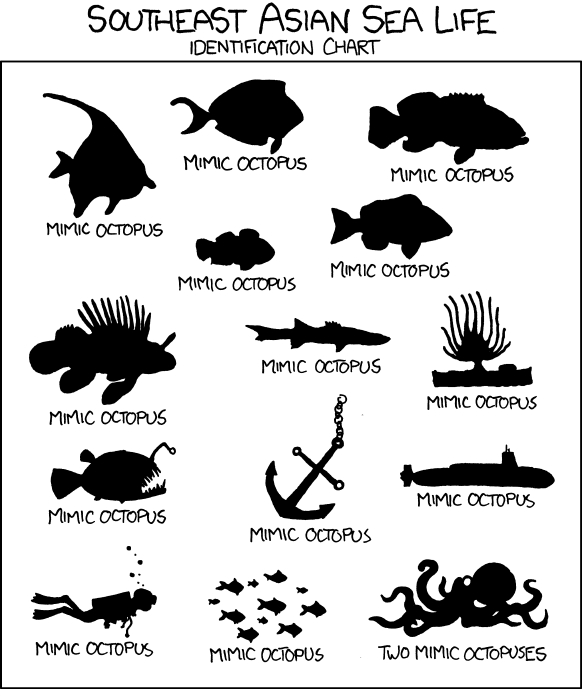
"Southeast Asian Sea Life" according to xkcd

From xkcd.com by Randall Munroe
The latest comic from this popular geeky web-comic pays tribute to the mimic octopus, whose camouflage powers have gained it minor celebrity status on YouTube...

Tuesday, July 12, 2011

Snails surviving being eaten by birds

Japanese scientists have found that small land snails of the species Tomatellides boeningi can survive being eaten by birds. They fed live snails to Japanese white-eyes and a brown-eared bulbul, and found that about 15% of the snails remained alive after passing through the birds' guts.

Just as birds are important dispersers of plant seeds, it appears that they can contribute to the dispersal of small animals too.

Wild populations of T. boeningi on Hahajima Island in the W Pacific show genetic heterogeneity within populations and no evidence of isolation, and there is a statistically-significant positive correlation between genetic variation and the density of Japanese white-eyes, lending support to the idea of bird-borne dispersal.

Sources:

Saturday, January 08, 2011

Ammonite Jaws Reconstructed in 3D with X-rays

Ammonites are common fossils with distinctive chambered spiral shells – so common that they're probably some of the first fossils most of us encounter, as decorative objects sitting prettily in someone's home or workplace. They're cephalopods, extinct relatives of the octopus, squid, and cuttlefish, but unlike these, have an external shell. The still-extant Nautilus is a cephalopod with an external shell, and is often confused with the ammonites, but these two actually represent two different lineages within the cephalopods.

Like most molluscs, ammonites had a (presumably) chitinous feeding apparatus comprising jaws and a radula–a rasping row of teeth-like structures unique to molluscs. These have been recovered occasionally in the past, but using X-rays, these have been studied in-situ in the ammonite Baculites from the Upper Cretaceous of South Dakota, allowing them to be reconstructed in breathtaking, 3-dimensional detail (paper in Science).

What's more, the food of these creatures can also be detected and identified. Within the buccal mass of these ammonites were fragments of small isopods, also called pill-bugs, which are crustaceans that, as their name suggests, look like rounded pills.

Unlike Nautilus and other nautiloids, the jaw structure and the kind of food they ate suggest that Baculites fed on small prey in the water column (i.e. zooplankton), instead of larger prey on the sea floor (benthic). They hypothesize that this preference for planktonic food may be responsible for the extinction of ammonites at the end of the Cretaceous, when the composition of planktonic communities changed considerably, but this theory will certainly have to be tested with more fossil data, as the commentary article points out.

Sunday, February 24, 2008

Secrets of cuttlefish camouflage

Secrets of the Camouflage Masters. Cuttlefish seem to be able to camouflage themselves against any sort of background - rocks and pebbles, corals, even checkerboards. Robert Hanlon of the Woods Hole Marine Biological Laboratory has classified the different cuttlefish camouflage patterns and shown that they fall into three broad categories - uniform colour, mottled colour, and disruptive patterns (like stripes and spots). According to the article: "What he learned from cephalopods may apply throughout the animal kingdom. The fact that cephalopods may need just three camouflage categories could mean that there are just a few basic ways to fool predators." That puts a new spin on the age old problem of animal camouflage and concealment. The question to ask might not be 'why are these animal so good at blending into the background' but rather 'why are we (or why are predators) so bad at spotting these particular kinds of patterns against the background?' A predator-centered approach might need to bring in theories of cognition and pattern-recognition.

One puzzling problem remains, though. Cuttlefish are colour blind yet they can adopt different colours in their camouflage. How do they manage to do so? No one yet knows....